Meet Damiana
Plant Ally Profile
Turnera diffusa
Pleasure • Joy • Vitality • Sensuality • Delight • Participation
The herb of pleasure, vitality, and joyful participation in life.
Damiana is a plant of pleasure.
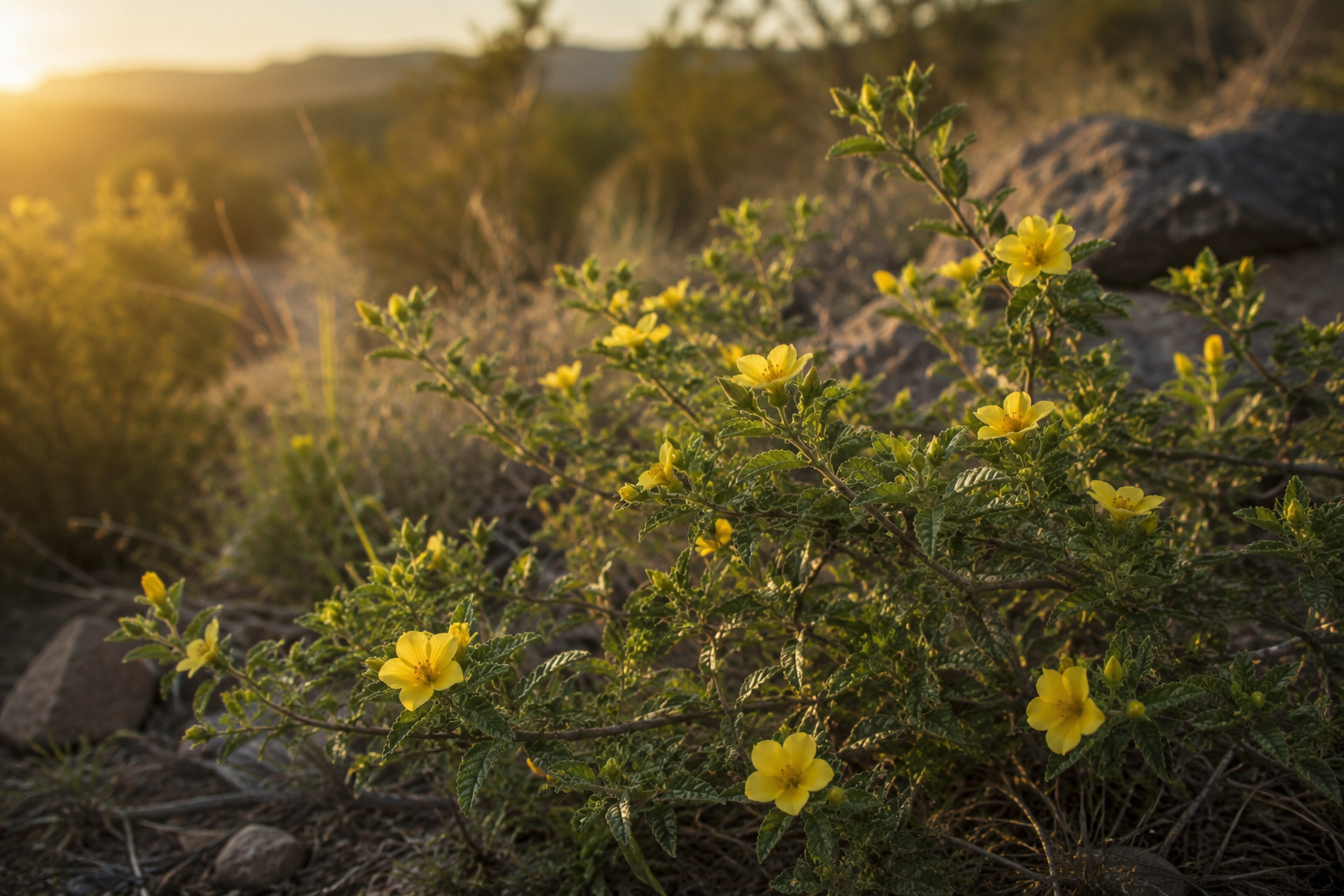
For generations, Damiana has been cherished as a plant of pleasure, vitality, and joyful participation in life. Native to the warm regions of Mexico, Central America, the Caribbean, the American Southwest, and here in Texas, she grows as a small aromatic shrub adorned with cheerful yellow flowers. Her leaves carry a distinctive spicy-sweet fragrance and have long been prepared as teas, tonics, and traditional herbal remedies.
The Maya regarded Damiana as a valuable aphrodisiac and restorative herb, a reputation she carries to this day. Yet reducing Damiana to an aphrodisiac alone misses much of her story.
Damiana is both a nervous system tonic and a reproductive tonic. Traditionally used for stress, fatigue, nervous exhaustion, diminished vitality, and low desire, she is less a plant of stimulation than one of restoration. Rather than forcing energy where none exists, Damiana appears to help rekindle the vitality that allows pleasure, creativity, sensuality, and engagement to arise naturally.
Traditional herbal literature also describes Damiana as a reproductive restorative for both men and women. She has been used to support libido diminished by stress, reproductive weakness, menstrual discomfort, and aspects of urinary and prostate health. Older Eclectic physicians valued her as a general tonic for nervous system depletion, urinary irritation, and reproductive complaints, often emphasizing her ability to strengthen rather than merely stimulate.
She is often introduced as an aphrodisiac. While desire is certainly part of her story, Damiana's gifts reach much further.
She has a remarkable way of drawing our attention back toward the things that make life worth experiencing.
The warmth of sunlight on skin. A shared meal. Laughter with friends. Music that moves through the body.
The quiet satisfaction of feeling fully present in a moment.
Damiana carries a bright and uplifting spirit.
Many herbalists turn to her during times when life feels dull, uninspired, or disconnected. She has long been used to support mood, vitality, sensuality, reproductive wellness, and emotional well-being.
Her medicine is often subtle. Less like a surge of energy and more like a gentle rekindling.
A renewed appreciation for beauty. A renewed capacity for delight. A renewed willingness to participate in life.
Across traditions, a common theme emerges: Pleasure.
Pleasure as participation.
Pleasure as vitality.
Pleasure as the ability to fully experience the life unfolding around us.
For this reason, Damiana has become one of my favorite herbs for supporting what I think of as vital pleasure: the ability to fully experience and enjoy the life that is already here.
How to Work With This Ally
Damiana may be especially supportive during seasons that call for joy, connection, creativity, sensuality, or renewed engagement with life.
I have also worked with Damiana to support urinary urgency, urge incontinence, and other concerns that commonly arise during midlife and the menopausal transition. When we are not preoccupied by discomfort, urgency, or interruption, it becomes easier to fully inhabit the present moment. In this way, she helps remove obstacles to presence, allowing greater ease, confidence, and enjoyment in daily life.
Damiana is a wonderful companion for gatherings, romance, celebration, creative work, and moments of intentional pleasure.
I have worked with her as a tea, tincture, smoking blend, and as a cordial.
Her medicine feels like an invitation.
An invitation to slow down. To savor. To enjoy.
To become fully present with the life already unfolding around you.
For me, Damiana is a reminder that pleasure is a form of nourishment.
A vital component of a well-lived life.
Damiana stars in FireStarter, where her bright and uplifting nature complements herbs traditionally associated with vitality, connection, pleasure, and embodied presence.
Plant Profile
Botanical Name:Turnera diffusa
Family: Passifloraceae (Passionflower Family)
Parts Used: Leaf and flowering aerial parts
Energetics: Warming, drying
Primary Actions: Nervine tonic • Reproductive tonic • Aphrodisiac • Mild antidepressant • Metabolic stimulant • Urinary tonic
Traditional Uses: Mood support, vitality, sensuality, reproductive wellness, stress-related fatigue, emotional well-being
Notable Constituents: Flavonoids, volatile oils, arbutin, bitter principles, tannins
What Modern Research Suggests: Research suggests Damiana may support mood, vitality, sexual wellness, and healthy stress response. Traditionally used as an aphrodisiac, Damiana appears to work best when low desire is associated with fatigue, stress, or diminished vitality rather than hormonal dysfunction alone.
Plant Themes: Pleasure • Joy • Vitality • Delight • Sensuality • Participation
Esoteric Correspondences
♂ Mars • Fire 🜂
Pleasure • Attraction • Vitality • Desire • Embodiment • Delight • Transformation
Supporting connection with pleasure and beauty • Rekindling passion for life • Restoring creative and sensual vitality • Cultivating joy and sensual awareness • Inspiring participation in life • Engaging fully with the present moment
Plant Teaching: Pleasure is a form of nourishment.
References
Beyerl P. The Master Book of Herbalism.
Chevallier A. Encyclopedia of Herbal Medicine.
Cunningham S. Cunningham's Encyclopedia of Magical Herbs.
Easley T, Horne S. The Modern Herbal Dispensatory.
Ellingwood F. The American Materia Medica, Therapeutics and Pharmacognosy.
Grieve M. A Modern Herbal.
Harrison K. The Herbal Alchemist's Handbook: A Complete Guide to Magical Herbs and How to Use Them.
McGuffin M, et al. American Herbal Products Association's Botanical Safety Handbook.
Stansbury J. Herbal Formularies for Health Professionals, Volume 1: Digestion and Elimination.
This profile reflects both traditional herbal knowledge and modern scientific understanding. It is intended for educational purposes and should not replace individualized medical advice. As with all herbal medicines, consider the whole person, their health history, and appropriate safety precautions before use.
