Meet Licorice Root
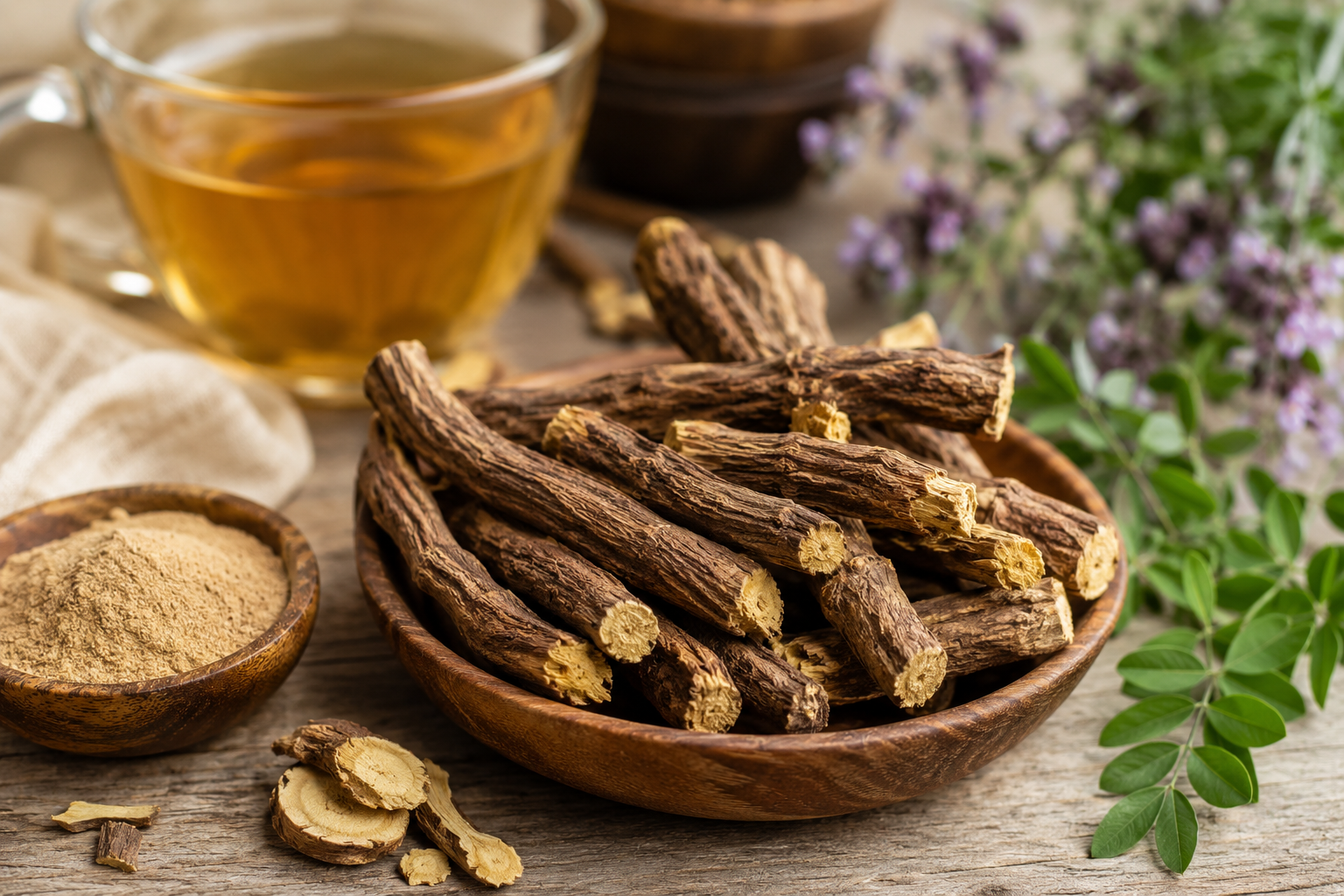
Plant Ally Profile
Glycyrrhiza glabra
Integrity • Restoration • Sweetness • Harmony • Resilience
The Medicine of Living Boundaries
Every day, your body meets the world through living boundaries.
The lining of your mouth welcomes each meal. Your throat carries every word you speak. Your stomach withstands powerful acid without digesting itself. Your lungs greet every breath, while your intestines decide what may enter and what must remain outside. These delicate tissues are among the hardest-working in the body, quietly protecting us every moment of every day.
When those boundaries become dry, inflamed, irritated, or worn thin, Licorice steps forward.
For thousands of years, Licorice has been cherished across Chinese, Ayurvedic, European, Middle Eastern, and Indigenous North American traditions as a remarkable restorative. Again and again, she appears wherever tissues need protection, inflammation needs calming, or resilience has been depleted. She coats irritated throats, comforts inflamed stomachs, supports damaged intestinal lining, protects the liver, eases dry coughs, and gently helps exhausted systems regain their footing.
Yet Licorice's gift reaches deeper than soothing alone.
She encourages tissues to recover their integrity. She supports healthy mucus production, strengthens the body's protective barriers, and helps restore balance where irritation has lingered too long. Modern herbalists rely on her to support healthy mucosal function throughout the digestive, respiratory, and urinary tracts, and traditional herbalists recognized her ability to harmonize formulas, soften harsher herbs, and help medicines work together more gracefully.
Maybe Licorice's greatest lessons are about boundaries in relationship.
Healthy boundaries are not rigid walls. They are living, responsive places where relationship happens. A healthy intestinal lining nourishes without leaking. Healthy lungs receive fresh air while keeping unwanted invaders at bay. A balanced immune system recognizes friend from foe. Healthy relationships depend upon knowing where one thing ends and another begins.
Licorice reminds us that resilience grows by tending the quiet places that hold everything together.
How to Work With This Ally
Licorice rarely asks to stand at the center of a formula. Instead, she works quietly behind the scenes, harmonizing her companions while offering steady support of her own. This has made her one of the most frequently used herbs in Traditional Chinese Medicine, where she is valued not only for her own medicinal actions but also for her remarkable ability to soften harsh formulas, improve flavor, and help diverse herbs work together as a cohesive whole.
She is especially at home wherever tissues have become irritated, inflamed, dry, or depleted. Herbalists reach for Licorice to soothe sore throats and dry coughs, comfort inflamed digestive tissues, support healthy intestinal barrier function, promote liver health, and help restore resilience after prolonged periods of physical or emotional stress. Her influence extends beyond the digestive tract to the respiratory and urinary systems, where healthy mucous membranes are equally essential.
Licorice is also an important ally for restoring balance. Rather than simply stimulating or suppressing immune activity, she helps regulate it. Rather than merely coating damaged tissue, she encourages healing and renewal. Rather than forcing the body into action, she supports its own remarkable capacity for repair.
Because Licorice influences cortisol metabolism and electrolyte balance, she is best worked with intentionally. Traditionally, she is most often used in moderate amounts as part of balanced formulas rather than as a long-term daily single herb. Those with high blood pressure, kidney disease, hypokalemia, or who are pregnant should consult a qualified healthcare practitioner before using Licorice medicinally.
She lends her soothing presence to Daily Grind, where she rounds the flavor while supporting recovery from the effects of chronic stress. In the Groundworks series, she joins glutamine and other restorative allies to help nourish and rebuild healthy intestinal barrier function. She also appears in XIV. Temperance Tea, where lends her harmonizing skills to the alchemical blend.
Licorice Root is one of the quiet cornerstones of the Plant Alchemy Apothecary. While she occasionally takes a leading role, she is more often chosen for her remarkable ability to harmonize formulas, soothe irritated tissues, and restore resilience wherever it is needed.
You will find Licorice throughout several Plant Alchemy formulations, including:
Daily Grind | Tea & Tincture
Groundworks | Gut Health Series
GateKeeper | Oral Health Collection
Common Ground | Botanical Tea
Plant Profile
Botanical Name:Glycyrrhiza glabra L.
Family: Fabaceae
Common Names: Licorice • Liquorice • Sweet Root • Gan Cao (Chinese)
Part Used: Root
Energetics: Warm • Moist
Taste: Sweet • Slightly Bitter
Primary Actions: Demulcent • Mucosal Restorative • Immune Modulator • Anti-inflammatory • Expectorant • Hepatoprotective • Adaptogenic Ally* • Endocrine Supportive • Harmonizing Herb
*Licorice is best described as an atypical adaptogen because it helps preserve the body's own cortisol activity rather than lowering elevated cortisol as many adaptogens do.
Traditional Uses: Digestive support • Dry coughs • Sore throats • Gastritis • Peptic ulcers • Healthy liver function • Immune balance • Adrenal support • Healthy aging • Vitality
Notable Constituents: Glycyrrhizin • Glycyrrhetinic Acid • Liquiritin • Isoliquiritin • Flavonoids • Polysaccharides • Isoflavones (including Genistein) • Phytosterols
Modern Research: Modern research continues to validate Licorice's longstanding reputation as a restorative herb for mucosal tissues. Studies have demonstrated its ability to support healthy mucus production, promote epithelial integrity, modulate immune activity, support healthy inflammatory balance, protect liver tissue, assist adrenal physiology by slowing cortisol metabolism, and help restore irritated tissues throughout the digestive, respiratory, and urinary systems.
Esoteric Correspondences
♀ Venus • ☿ Mercury • Water 💧
Plant Themes: Integrity • Restoration • Sweetness • Harmony • Resilience • Healthy Boundaries
EsotericApplications: Strengthening healthy boundaries • Restoring what has been worn thin • Harmonizing opposing forces • Encouraging compassionate communication • Supporting resilience after prolonged stress • Remaining open without becoming overwhelmed
Plant Teaching: "Good fences make good neighbors."
References
Beyerl, Paul. The Master Book of Herbalism.
Chevallier, Andrew. Encyclopedia of Herbal Medicine.
Cunningham, Scott. Cunningham's Encyclopedia of Magical Herbs.
Dunwich, Gerina. Herbal Magick: A Guide to Herbal Enchantments, Folklore, and Divination.
Garrett, J. T. The Cherokee Herbal: Native Plant Medicine from the Four Directions.
Harrison, Karen. The Herbal Alchemist's Handbook: A Complete Guide to Magical Herbs and How to Use Them.
McGuffin, Michael, et al. Botanical Safety Handbook. 2nd ed.
Stansbury, Jill. Herbal Formularies for Health Professionals, Volume 1: Digestion and Elimination.
Weed, Susun S. Wise Woman Herbal for the Childbearing Year.
Winston, David. Adaptogens: Herbs for Strength, Stamina, and Stress Relief.
Wood, Matthew. The Earthwise Herbal, Volume I: A Complete Guide to Old World Medicinal Plants.
