Rosehip Seed Oil
← Return to The Plant Alchemy Guide to Botanical Oils
Few botanical oils have earned the reputation of rosehip seed oil, and fewer still have justified it so completely. Lightweight yet remarkably nutrient-dense, rosehip seed oil has become a cornerstone of modern botanical skincare because of its exceptional concentration of essential fatty acids and naturally occurring antioxidant compounds. Together, these constituents support the skin barrier, help defend against oxidative stress, and contribute to healthy, resilient skin.
Unlike many botanical oils prized primarily for their emollient qualities, rosehip seed oil contributes meaningful biological activity of its own. Its chemistry makes it particularly well suited to mature, dry, environmentally stressed, and barrier-impaired skin, while its elegant skin feel allows it to absorb quickly without leaving a heavy or greasy finish.
Its greatest strength, however, lies not in any single constituent, but in the remarkable harmony of its lipid chemistry. Rich in linoleic and α-linolenic acids, supported by tocopherols, carotenoids, and phytosterols, rosehip seed oil exemplifies one of the central principles of botanical formulation: the whole is often greater than the sum of its parts.
At Plant Alchemy, we describe rosehip seed oil as a botanical that supports healthy aging or, as we affectionately say around the formulation bench, "anti-gravity." Not because it defies physics, but because few botanical oils rival its ability to support skin that has begun to lose elasticity, resilience, and vitality.
Identity Card
Botanical Name: Rosa canina L., Rosa rubiginosa L. (syn. Rosa eglanteria), Rosa moschata, and other Rosa species cultivated for their seeds
Plant Family: Rosaceae
Plant Part: Seeds
Native Range: Europe, western Asia, and North Africa, with modern commercial production concentrated in Chile, Argentina, South Africa, and parts of Europe.
Extraction Method: Cold-Pressed
Extraction Quality: Virgin, unrefined (preferred)
INCI Name: Most commonly Rosa Canina Seed Oil, though the INCI reflects the species used.
Primary Lipids
Linoleic Acid (Omega-6)
α-Linolenic Acid (Omega-3)
Oleic Acid (Omega-9)
Palmitic Acid
Stearic Acid
Key Constituents
Tocopherols (predominantly γ-tocopherol)
β-Sitosterol and other phytosterols
Carotenoids
Phenolic compounds
Trace squalene
Skin Feel
Lightweight • Velvety • Dry finish
Absorption
Rapid
Oxidative Stability
Moderate
Shelf Life
Approximately 12 to 18 months under cool, dark storage. Because of its high polyunsaturated fatty acid content, rosehip seed oil oxidizes more readily than oils such as jojoba or squalane.
Typical Applications
Facial oils
Serums
Healthy aging formulations
Barrier-support formulations
Eye treatments
Botanical body oils
Primary Actions
Barrier Support
Emollient
Antioxidant
Skin Conditioning
Supports Healthy Aging
Botanical Background
Rosehip seed oil is pressed from the tiny seeds contained within the fruits, or "hips," of wild roses. While the fleshy hip is renowned for its exceptionally high vitamin C content, the seeds possess a very different chemistry. Rich in polyunsaturated lipids and lipid-soluble antioxidants, they yield an oil that has become one of the most valued botanical ingredients in contemporary skincare.
Because the seeds and the fleshy hips possess very different chemical compositions, the two are often mistakenly discussed as though they were interchangeable. While rose hips are renowned for their vitamin C content, cold-pressed rosehip seed oil derives its value primarily from its lipids and lipid-soluble phytochemicals.
Several species contribute to the commercial market, most notably Rosa canina and Rosa rubiginosa. Although subtle differences exist among species and growing regions, their oils share a remarkably similar therapeutic profile. All are characterized by high concentrations of linoleic and α-linolenic acids, moderate oleic acid, naturally occurring tocopherols and phytosterols, and a comparatively low oxidative stability that reflects their abundance of polyunsaturated fatty acids.
For the botanical formulator, these characteristics define rosehip seed oil far more than the species name on the label. Understanding its chemistry explains both its remarkable benefits and its limitations, making it an excellent example of why thoughtful oil selection matters in every formulation.
Traditional Use
Although rosehip seed oil is a comparatively modern addition to botanical skincare, the rose itself has been revered for centuries in traditional medicine. Across Europe, the Middle East, and parts of Asia, rose hips were valued as nourishing fruits rich in vitamins and used to support vitality, recovery, and resilience. The cold-pressed seed oil emerged much later as advances in extraction technology made it possible to preserve the delicate lipids and antioxidant compounds contained within the seeds.
Today, rosehip seed oil is valued less for historical tradition than for its well-characterized chemistry. Its reputation has been built through a growing body of research demonstrating its ability to support the skin barrier, improve hydration, reduce transepidermal water loss, and promote a healthy, resilient complexion.
The widespread cosmetic use of rosehip seed oil is largely a product of modern extraction technology and contemporary dermatological research rather than ancient herbal tradition. Although the rose has been revered for centuries, our understanding of the seed oil's remarkable chemistry is comparatively recent.
Extraction & Processing
High-quality rosehip seed oil is obtained through mechanical cold pressing of cleaned, dried rose seeds. Cold pressing preserves the oil's delicate polyunsaturated fatty acids, tocopherols, carotenoids, and phytosterols while minimizing thermal degradation.
Because rosehip seed oil contains a high proportion of polyunsaturated lipids, extraction and storage conditions significantly influence quality. Exposure to excessive heat, oxygen, or light accelerates oxidation and shortens shelf life. Virgin, unrefined oils typically retain the greatest concentration of naturally occurring antioxidants and display a characteristic golden to deep amber hue.
Extraction temperature is critical. Excessive heat accelerates degradation of polyunsaturated fatty acids and reduces concentrations of naturally occurring antioxidant compounds, making true cold pressing the preferred method for preserving the oil's biological activity.
Lipid Composition
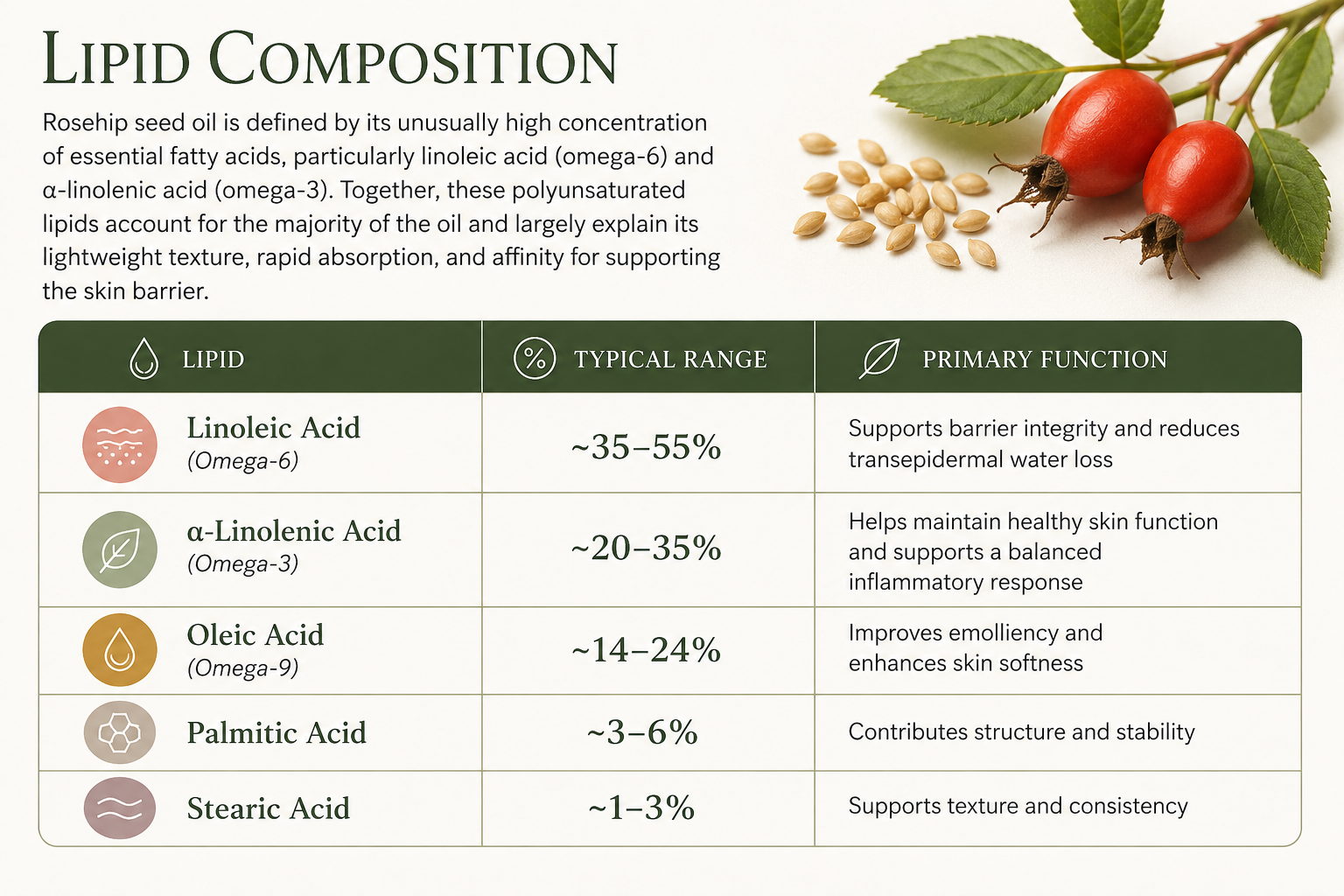
Rosehip seed oil is defined by its unusually high concentration of essential fatty acids, particularly linoleic acid (omega-6) and α-linolenic acid (omega-3). Together, these polyunsaturated lipids account for the majority of the oil and largely explain its lightweight texture, rapid absorption, and affinity for supporting the skin barrier.
Unsaponifiable Constituents
Although these compounds comprise only a small percentage of the oil, they contribute disproportionately to its biological activity and help explain why whole botanical oils often outperform isolated lipid fractions.
Tocopherols (Vitamin E Compounds) provide antioxidant protection for both the oil and the skin while helping improve oxidative stability.
Phytosterols, particularly β-sitosterol, support skin barrier recovery and help calm visible irritation.
Carotenoids contribute antioxidant activity while giving unrefined rosehip seed oil its characteristic golden-orange color.
Rosehip also contains smaller quantities of phenolic compounds and other naturally occurring antioxidants that work synergistically with its lipid profile.
Skin Physiology & Mechanisms of Action
The skin barrier depends upon a balanced lipid matrix to retain moisture and defend against environmental stressors. Rosehip seed oil complements this biology by supplying abundant essential fatty acids that support barrier function while helping reduce transepidermal water loss.
Its naturally occurring antioxidant constituents help protect surface lipids from oxidative stress, while its lightweight texture allows rapid absorption without leaving a heavy residue. This combination makes rosehip particularly well suited to mature, dry, environmentally stressed, and barrier-impaired skin.
Importantly, rosehip functions as a supportive botanical ingredient rather than a pharmaceutical intervention. Its value lies in promoting healthy skin physiology over time through consistent use.
Clinical & Experimental Research
Although human clinical research remains limited, the available evidence is encouraging. Laboratory studies consistently demonstrate antioxidant activity, barrier-supportive effects, and a favorable lipid composition, while emerging human research suggests meaningful cosmetic benefits.
In a 2025 pilot study involving 27 adults, twice-daily application of cold-pressed Rosa canina seed oil for five weeks resulted in measurable improvements in wrinkle appearance, skin texture, pore visibility, and several indicators of overall skin quality as assessed using VISIA facial imaging. Because the study was small, open-label, and lacked a placebo control, these findings should be interpreted cautiously. Nevertheless, they provide early clinical support for rosehip seed oil as a promising botanical ingredient for healthy aging formulations.
Overall, the available evidence supports rosehip seed oil as a well-characterized botanical oil whose chemistry aligns closely with both its traditional appreciation and its contemporary cosmetic applications.
Formulation Characteristics
Rosehip seed oil contributes a lightweight, elegant skin feel with rapid absorption and minimal residue. It layers well beneath heavier botanical oils and is particularly effective in facial oils, serums, emulsions, and barrier-support formulations.
Because of its high polyunsaturated fatty acid content, rosehip is rarely used as the sole lipid in a formulation. Pairing it with more oxidatively stable oils such as squalane or sweet almond oil improves both shelf stability and sensory performance while preserving rosehip's unique therapeutic contribution.
Rosehip seed oil also blends exceptionally well with oils rich in monounsaturated lipids, allowing formulators to balance restorative activity with improved oxidative stability and enhanced sensory elegance.
Stability & Storage
Rosehip seed oil is moderately oxidatively stable but considerably less stable than oils rich in monounsaturated lipids or wax esters.
Store tightly sealed in dark glass away from heat, light, and oxygen. Refrigeration after opening may further extend shelf life. Formulations often benefit from the inclusion of mixed tocopherols as antioxidants to help slow oxidation.
For this reason, many formulators package rosehip-rich formulations in opaque or UV-protective glass and include mixed tocopherols to further protect against oxidation.
Safety Considerations
Rosehip seed oil is generally well tolerated and is considered suitable for most skin types. Adverse reactions are uncommon but remain possible in individuals with sensitivities to botanical ingredients.
As with any cold-pressed botanical oil, quality, freshness, and appropriate storage significantly influence both performance and safety.
Sustainability & Sourcing
Commercial rosehip seed oil is produced primarily in Chile and Argentina, where several wild and cultivated Rosa species thrive. Sustainable harvesting practices and careful post-harvest processing are essential for preserving both ecological integrity and oil quality.
When selecting rosehip seed oil, preference should be given to reputable producers who prioritize traceability, responsible cultivation, and low-temperature processing methods.
Formulator's Insight
Rosehip seed oil earns its place in Afterglow Botanical Body Oil and Veil Active Botanical Facial Serum because it brings something to the formulations that few botanical oils can offer: an exceptional concentration of essential fatty acids paired with naturally occurring antioxidant compounds in an elegant, fast-absorbing oil.
Its chemistry makes it particularly valuable for skin experiencing the visible effects of time, environmental stress, or barrier disruption. Rich in linoleic and α-linolenic acids, rosehip helps replenish lipids that support a healthy skin barrier, while carotenoids, tocopherols, and phytosterols contribute antioxidant protection and skin-conditioning benefits.
Yet rosehip's greatest strength is also its greatest limitation. Its abundance of polyunsaturated fatty acids makes it inherently less oxidatively stable than many botanical oils. Rather than viewing this as a weakness, we see it as an invitation to formulate intelligently.
In Afterglow, rosehip is intentionally paired with highly stable, complementary lipids including squalane and sweet almond oil, along with evening primrose oil to create a formulation that balances restorative activity with exceptional elegance, stability, and everyday wearability. Each oil contributes something the others cannot, creating a blend whose performance exceeds that of any single ingredient alone.
In Veil, rosehip seed oil is thoughtfully paired with biomimetic squalane, camellia seed oil, jojoba, and prickly pear seed oil to create a lightweight lipid foundation that nourishes the skin barrier while delivering exceptional elegance and stability. This botanical framework supports the active layer of bakuchiol, bisabolol, and tocopherol, allowing each ingredient to contribute its unique strengths in a formulation designed to promote healthy aging, resilience, and luminous skin.
This philosophy lies at the heart of Plant Alchemy formulation. We do not search for miracle ingredients. We cultivate thoughtful relationships between plants, allowing each botanical to contribute its unique strengths while supporting the whole.
Featured In
Afterglow | Botanical Facial Oil
Rosehip seed oil serves as one of the foundational botanical oils in Afterglow, where it is paired with squalane, evening primrose oil, and sweet almond oil to create a lightweight facial oil that supports barrier function, healthy aging, and lasting skin vitality. Each oil was selected for its unique chemistry, creating a formulation whose performance exceeds that of any individual ingredient alone.
Veil | Botanical Facial Oil
Rosehip seed oil serves as one of the foundational botanical oils in Veil, where it is paired with olive squalane, camellia seed oil, jojoba oil, and prickly pear seed oil to create a refined lipid matrix that supports barrier function, healthy aging, and lasting skin vitality. This botanical foundation is complemented by bakuchiol, bisabolol, and tocopherol, creating a formulation that balances restorative plant chemistry with modern cosmetic science. Each ingredient was selected for its unique chemistry, allowing the formulation to deliver results that exceed those of any single botanical or active ingredient alone.
Explore the Behind the Bottle essay to learn more about the formulation philosophy behind Veil.
Explore the Behind the Bottle essay to learn more about the formulation philosophy behind Afterglow.
← Return to The Plant Alchemy Guide to Botanical Oils
Key References
Hatipoğlu, S. D., & Ak, G. (2023). Rosa canina seed oil: Chemical composition, biological properties, and cosmetic applications.
Mannozzi, C., et al. (2020). Characterization of Lipid Substances of Rose Hip Seeds as a Potential Source of Functional Components: A Review.
Oargă, D. P., Cornea-Cipcigan, M., Nemes, S. A., & Cordea, M. I. (2025). The Effectiveness of a Topical Rosehip Oil Treatment on Facial Skin Characteristics: A Pilot Study on Wrinkles, UV Spots Reduction, Erythema Mitigation, and Age-Related Signs.Cosmetics, 12(3), 125.https://doi.org/10.3390/cosmetics12030125
Popović-Djordjević, J., et al. (2023). Rosehip seed oil composition and variability among Rosa species.
Turan, S., et al. (2018). Bioactive Lipids, Antiradical Activity and Stability of Rosehip Seed Oil under Thermal and Photo-Induced Oxidation.
Vasić, D., Paunović, D., Špirović-Trifunović, B., Miladinović, J., Vujošević, L., Đinović, D., & Popović-Djordjević, J. (2020). Fatty Acid Composition of Rosehip Seed Oil.Acta Agriculturae Serbica, 25, 45-49.
Applied Sciences (2025). Review article on rosehip seed oil chemistry, biological activity, and cosmetic applications. (Use the full citation from your PDF.)
Pharmacia (2025). Review article on Rosa canina seed oil in dermatology and cosmetic science. (Use the full citation from your PDF.)
