Evening Primrose Oil
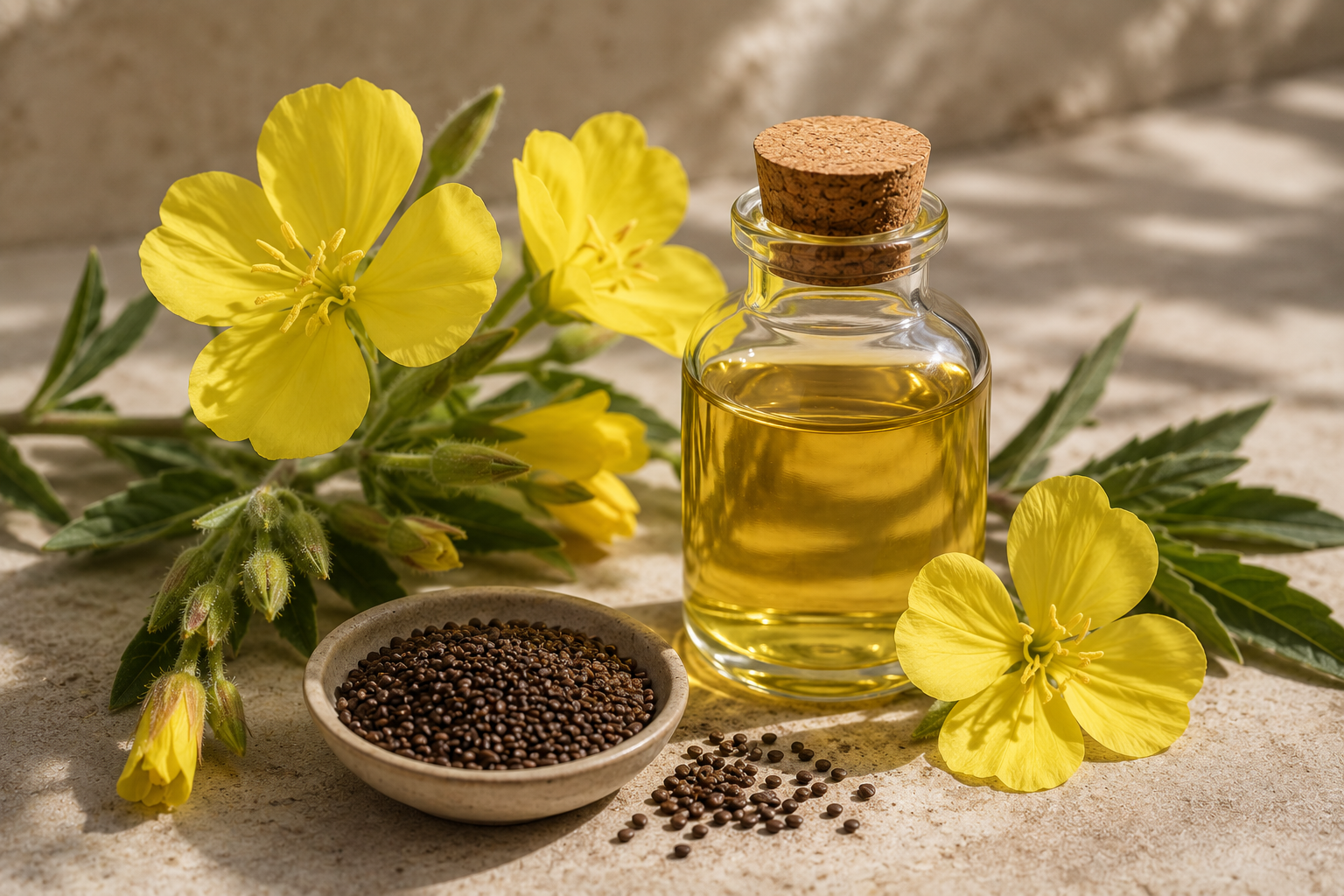
The Essential Fatty Acid Specialist
Introduction
Few botanical oils have earned as much scientific attention for skin barrier support as Evening Primrose oil. Pressed from the tiny seeds of Oenothera biennis, this lightweight golden oil is distinguished by one remarkable characteristic: its naturally high concentration of gamma-linolenic acid (GLA), a rare omega-6 fatty acid that plays an important role in maintaining healthy skin structure and regulating cutaneous inflammation.
Gamma-linolenic acid is found in meaningful concentrations in only a handful of botanical oils, making Evening Primrose one of nature's most accessible sources of this physiologically important fatty acid.
While most plant oils nourish primarily through emolliency, Evening Primrose offers something more nuanced. Its unique fatty acid profile provides many of the building blocks required for healthy epidermal function, helping replenish lipids that are gradually depleted through aging, environmental stress, excessive cleansing, and chronic skin irritation.
For formulators, Evening Primrose occupies a unique position between active botanical extract and carrier oil. It contributes elegant sensory qualities while simultaneously supporting the skin's own repair mechanisms. This dual role has made it a respected ingredient in formulations designed for dry, sensitive, reactive, and mature skin for decades.
Evening Primrose remains one of cosmetic science's most respected specialty oils in skincare today.
Identity Card
Botanical Name
Oenothera biennis L.
Family
Onagraceae
Common Names
Evening Primrose, Common Evening Primrose
Plant Part Used
Seeds
Extraction Method
Cold-pressed seed oil
Appearance
Clear to pale golden-yellow liquid
Aroma
Very mild with a faint nutty aroma
Texture
Lightweight, silky, rapidly absorbed
Absorption Speed
Fast
Primary Fatty Acids
Linoleic Acid (Omega-6): 65-80%
Oleic Acid (Omega-9): 6-12%
Gamma-Linolenic Acid (GLA): 8-10%
Palmitic Acid: 5-7%
Stearic Acid: 1-3%
Rich In
Gamma-linolenic acid (GLA)
Phytosterols
Tocopherols
Polyphenolic antioxidants
At a Glance
Best For
Dry skin
Sensitive skin
Mature skin
Compromised skin barrier
Reactive skin
Barrier recovery formulations
Skin Feel
Silky, lightweight, elegant.
Oxidative Stability
Moderate. Refrigeration and antioxidant protection are recommended after opening.
Comedogenic Rating
Approximately 2
Pairs Well With
Squalane
Jojoba
Rosehip Seed Oil
Camellia Seed Oil
Bisabolol
Bakuchiol
Ceramides
Botanical Background
Native to eastern and central North America, Evening Primrose has naturalized across Europe and much of the world. The biennial produces cheerful yellow flowers that unfurl rapidly at dusk, often opening within minutes as daylight fades. This unusual flowering habit gives the plant both its common name and much of its folklore.
Long before it entered cosmetic laboratories, Indigenous peoples utilized various parts of the plant as food and medicine. The roots, leaves, and seeds were traditionally prepared for a wide variety of purposes, while the seeds themselves quietly contained what would later become one of dermatology's most fascinating botanical lipids.
Commercial production today focuses almost entirely on the seeds, which yield approximately 20 to 30 percent oil when carefully cold pressed.
Traditional Use
Historically, Evening Primrose was valued as a useful medicinal and edible plant rather than simply a cosmetic ingredient. Traditional applications emphasized soothing irritated tissues and supporting overall wellness.
Its rise within modern skincare occurred much later, after researchers identified gamma-linolenic acid as one of the few plant-derived sources of this physiologically important fatty acid.
This discovery shifted Evening Primrose from herbal curiosity to dermatologic ingredient, leading to decades of investigation into barrier repair, inflammation, and epidermal lipid metabolism.
Extraction & Processing
Premium Evening Primrose oil is produced through mechanical cold pressing of cleaned, dried seeds.
Unlike solvent extraction, cold pressing preserves delicate polyunsaturated fatty acids while minimizing degradation of naturally occurring tocopherols and phytosterols.
Because the oil contains a high percentage of polyunsaturated fatty acids, careful processing is essential. Excessive heat, oxygen exposure, or prolonged storage rapidly accelerate oxidation.
For cosmetic use, high-quality oils are typically:
Cold pressed
Minimally refined
Nitrogen flushed
Protected with mixed tocopherols
Packaged in opaque containers
Lipid Composition
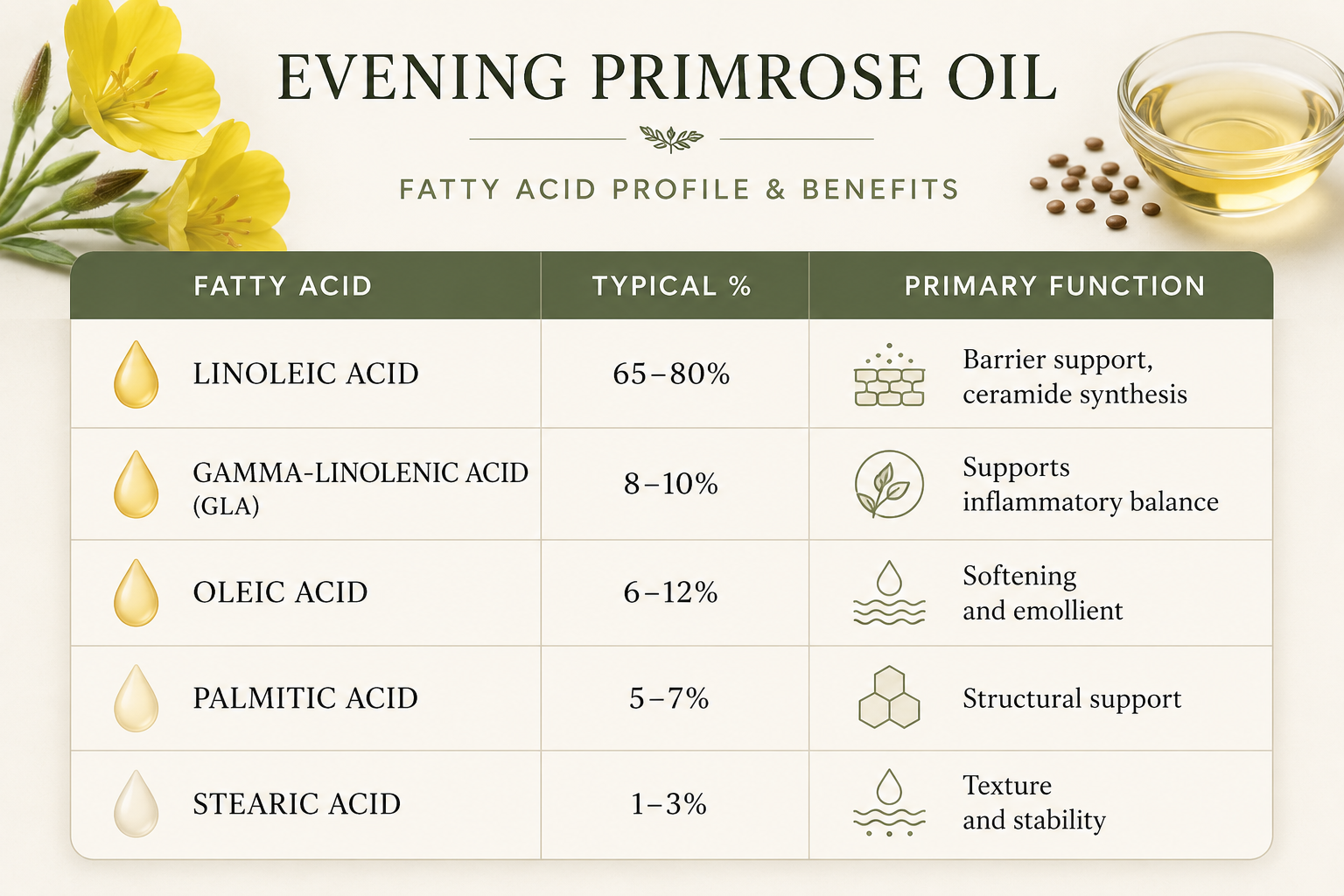
Unlike many cosmetic oils, Evening Primrose derives much of its value from the interaction between linoleic acid and gamma-linolenic acid. Together they help replenish epidermal lipids while supporting healthy skin barrier function.
Unsaponifiable Constituents
Although present in relatively small amounts, the unsaponifiable fraction contributes meaningful biological activity.
Phytosterols that support barrier repair
Mixed tocopherols providing antioxidant protection
Polyphenolic compounds
Trace squalene
Minor phospholipids
These constituents enhance both stability and skin compatibility beyond what fatty acids alone would predict.
Skin Physiology & Mechanisms of Action
Healthy skin depends upon an intact lipid barrier. Ceramides, cholesterol, and free fatty acids organize into microscopic lamellar structures that reduce transepidermal water loss (TEWL) while protecting against environmental stress.
Linoleic acid serves as a critical precursor for ceramide synthesis. When sufficient quantities are available, the skin can more effectively maintain barrier integrity, retain moisture, and resist external irritation.
Gamma-linolenic acid (GLA) provides an additional layer of support. Within the skin, GLA is converted into dihomo-gamma-linolenic acid (DGLA), a precursor to anti-inflammatory lipid mediators including prostaglandin E1 (PGE1). These compounds help regulate inflammatory signaling while supporting healthy epidermal homeostasis.
Together, these fatty acids replenish essential lipids while reinforcing the skin's own protective architecture rather than simply coating its surface.
This combination explains why Evening Primrose frequently appears in formulations intended for:
Dry skin
Sensitive skin
Mature skin
Environmentally stressed skin
Compromised barrier function
Evening Primrose helps restore the biochemical conditions under which healthy skin naturally performs.
Clinical & Experimental Research
Human clinical studies suggest topical Evening Primrose oil may improve skin hydration, smoothness, elasticity, and barrier function, particularly in dry or mature skin. Improvements are generally gradual and appear most consistent with continued use over several weeks.
Laboratory studies demonstrate that GLA supports epidermal lipid synthesis while helping regulate inflammatory signaling pathways involved in skin irritation.
Animal models similarly show improved barrier recovery following experimental disruption of the epidermis.
Oral Evening Primrose has been extensively studied for conditions such as atopic dermatitis and eczema. The biochemical rationale supporting cosmetic application is strong, and the ingredient remains widely respected among formulators because its composition aligns closely with established principles of skin barrier physiology.
Formulation Characteristics
Typical usage rates:
2-5% for lightweight facial serums
5-15% in barrier repair oils
Up to 20% in specialty treatment blends
Evening Primrose blends particularly well with more oxidation-resistant oils such as Squalane and Jojoba, allowing formulators to improve stability while preserving its beneficial lipid profile.
Its elegant slip also softens heavier botanical oils without creating an oily finish.
Stability & Storage
Because of its high concentration of polyunsaturated fatty acids, Evening Primrose oil is moderately susceptible to oxidation. Ironically, the same delicate fatty acids that make the oil biologically valuable also make it more vulnerable to degradation than many other carrier oils.
To maximize shelf life:
Store in tightly sealed containers.
Protect from heat and light.
Refrigerate after opening when practical.
Include mixed tocopherols in finished formulations.
Avoid prolonged air exposure during manufacturing.
Proper handling significantly extends stability while preserving the integrity of its sensitive fatty acids.
Safety Considerations
Evening Primrose Oil has an excellent safety profile when used in topical skincare formulations.
Skin irritation is uncommon, though individuals with seed allergies should exercise appropriate caution.
No significant phototoxicity has been reported.
Because oxidation products may increase irritation potential, only fresh, well-preserved oil should be incorporated into skincare formulations.
Sustainability & Sourcing
Evening Primrose is readily cultivated and is not considered threatened.
Responsible suppliers emphasize:
Sustainable agricultural practices
Cold pressing
Minimal refinement
Oxidation control throughout processing
Batch testing for purity and peroxide values
These practices help preserve both product quality and environmental stewardship.
Formulator's Insight
Evening Primrose contributes something more foundational: lipids the skin recognizes and knows how to use.
In Afterglow Botanical Body Oil, Evening Primrose complements Rosehip Seed Oil, Squalane, and Sweet Almond oil by helping replenish essential fatty acids while supporting the skin's natural moisture barrier. Its silky texture disappears effortlessly into the skin, bringing nourishment without heaviness and reinforcing the blend's goal of leaving skin soft, resilient, and comfortably hydrated.
Like many of the finest botanical ingredients, Evening Primrose helps healthy skin remain healthy while restoring comfort to skin challenged by time, environment, or daily life.
Key References
Harry's Harry's Cosmeticology, 9th Edition.
Poucher's Perfumes, Cosmetics and Soaps, 10th Edition.
AHPA Botanical Safety Handbook, 2nd Edition.
Simon D, et al. Gamma-Linolenic Acid Levels Correlate with Clinical Efficacy of Evening Primrose Oil in Patients with Atopic Dermatitis. Advances in Therapy. 2014.
Christie WW. Lipid Analysis: Isolation, Separation, Identification and Lipidomic Analysis, 4th Edition.
Huang TH-W, et al. Gamma-Linolenic Acid and Skin Barrier Function
