Meet Angelica
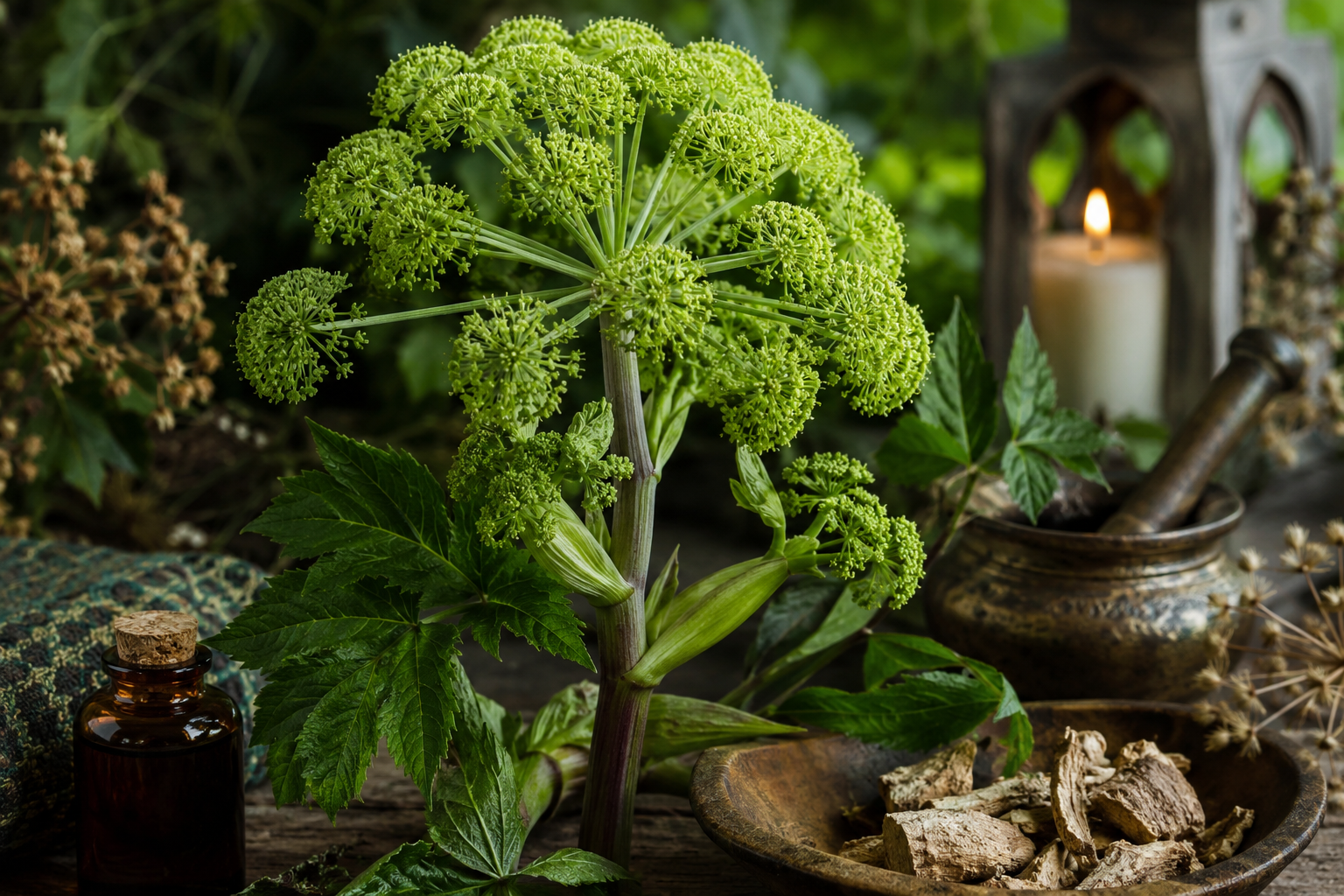
Plant Ally Profile
Angelica archangelica
Threshold • Protection • Warmth • Courage • Restoration
The Herald
Angelica calls.
She is a clarion. A clear note ringing across the veil, carrying prayer, courage, and remembrance where words alone cannot reach.
Her botanical name, archangelica, reflects a centuries-old association with the Archangel Michael, the great protector and guide. According to European tradition, Angelica came into bloom around Michaelmas, and legends tell that the Archangel revealed the plant's virtues during times of plague and uncertainty. Whether taken as history, folklore, or sacred story, the image has endured: Angelica appears wherever courage, protection, and faithful guidance are needed most.
Angelica has always been revered as a guardian of thresholds. She has walked beside those recovering from illness, mothers welcoming new life, elders rebuilding strength, travelers crossing uncertain roads, and souls preparing for their final journey. Across European folk medicine, Saami tradition, Cherokee herbalism, Hoodoo, and countless spiritual lineages, she appears wherever life asks us to move from one season into another.
Her medicine begins by restoring movement.
Where digestion has grown cold, she rekindles appetite. Where circulation has slowed, she warms the blood and calls it outward. Where the lungs have become burdened with dampness, she opens the breath. Where discouragement has settled into the spirit, she reminds us that vitality can return, one low-burning ember at a time.
Angelica has always been employed as a plant of protection, but her protection is active rather than defensive. She does not ask us to hide from the world. She helps us meet it with greater warmth, clearer perception, and renewed courage.
She is the plant ally for those standing at life's thresholds, where the old has ended, the new has not yet begun, and the path forward is revealed one faithful step at a time.
How to Work With This Ally
Angelica is a remarkable companion whenever life feels stagnant, depleted, or suspended between chapters.
In some Indigenous traditions, Angelica was considered a Bear medicine. Bears seek aromatic roots in the spring as they emerge from hibernation, rebuilding strength after the long winter. Like the first warmth of spring reaching cold earth, Angelica gently rekindles digestion, circulation, breath, and vitality until life begins moving again.
Traditionally, she has been used to warm sluggish digestion, stimulate appetite, improve circulation, support healthy respiratory function, encourage perspiration during illness, and promote healthy movement of blood and lymph. Modern herbalists continue to value her for cold constitutions, digestive weakness, respiratory congestion, poor peripheral circulation, and convalescence after illness.
Angelica has long accompanied those reclaiming themselves after seasons of depletion. Herbalists have used the root to support freedom from tobacco and alcohol, not only by helping lessen cravings, but by restoring the warmth, vitality, and inner steadiness that addiction so often erodes.
Energetically, Angelica reminds us that movement often begins with warmth.
She is especially supportive during seasons of transition: recovering from burnout, rebuilding after grief or illness, entering menopause, beginning a new vocation, leaving an old identity behind, or simply remembering how to breathe deeply again after a difficult season.
Many traditions also work with Angelica ceremonially. The dried root has long been carried as a protective talisman, burned as incense during prayer or meditation, added to dream pillows, or included in cleansing rituals to invite clarity, peace, and guidance.
She appears in Lineage, where her warming circulatory nature supports healthy blood movement while her deeper symbolism reminds us that healing often travels through generations as surely as blood itself. In DreamWeaver she stands at the threshold between waking and dreaming, a traditional guardian of sleep, vision, and the liminal spaces where insight often arrives.
Plant Profile
Botanical Name:Angelica archangelica
Family: Apiaceae
Parts Used: Root, seed, leaf, stem
Energetics: Warm • Aromatic • Drying • Diffusive
Primary Actions: Digestive tonic • Carminative • Circulatory stimulant • Diaphoretic • Expectorant • Alterative • Emmenagogue
Traditional Uses: Poor appetite • Indigestion • Gas and bloating • Bronchial congestion • Cold constitutions • Poor peripheral circulation • Convalescence • Menstrual stagnation • Fatigue
Modern Research: Studies support traditional uses through demonstrated anti-inflammatory activity, digestive stimulation, antimicrobial properties, and vascular effects, including support for healthy peripheral circulation and nitric oxide pathways. Commission E recognizes Angelica root for dyspeptic complaints including bloating, flatulence, mild gastrointestinal cramping, and insufficient gastric secretions.
Notable Constituents: Volatile oils • Coumarins • Furanocoumarins • Bitter compounds • Flavonoids • Organic acids • Phytosterols
Safety: Angelica is traditionally contraindicated during pregnancy because of its emmenagogue and uterine-stimulating actions. Root and seed preparations may increase photosensitivity in susceptible individuals due to naturally occurring furanocoumarins. As with all medicinal herbs, consult a qualified healthcare practitioner before use if you are pregnant, nursing, taking prescription medications, or managing a chronic medical condition.
Plant Themes: Thresholds • Protection • Vitality • Inner Fire • Guidance
Esoteric Correspondences
☉ Sun • 🔥 Fire
Protection • Courage • Purification • Prayer • Thresholds
Applications: Blessing rituals • Dream work • Threshold ceremonies • Meditation • Protection charms • Seasonal transitions • Grief work
Plant Teaching: Answer the call that awakens your soul.
Species Note: Several species are commonly called Angelica, including Angelica atropurpurea (American Angelica), Angelica sylvestris, and Angelica sinensis (Dong Quai). While these relatives share certain traditional qualities, this profile focuses specifically on Angelica archangelica, the European species long valued as a warming digestive, circulatory, and protective ally in Western herbalism.
References
Bennett, Robin Rose. The Gift of Healing Herbs: Plant Medicines and Home Remedies for a Vibrantly Healthy Life. Hay House, 2013.
Beyerl, Paul. The Master Book of Herbalism. Phoenix Publishing, 1984.
Bird, Stephanie Rose. Sticks, Stones, Roots & Bones: Hoodoo, Mojo & Conjuring with Herbs. Llewellyn Publications, 2004.
Buhner, Stephen Harrod. Herbal Antibiotics: Natural Alternatives for Treating Drug-Resistant Bacteria. 2nd ed., Storey Publishing, 2012.
Chevallier, Andrew. Encyclopedia of Herbal Medicine. 3rd ed., DK Publishing, 2016.
Cunningham, Scott. Cunningham's Encyclopedia of Magical Herbs. Llewellyn Publications, 1985.
Diaz, Juliet. Plant Witchery: Discover the Sacred Language, Wisdom, and Magic of 200 Plants. Hay House, 2020.
Dunbar, Joe. Secrets from an Herbalist's Garden: A Magical Year of Plant Remedies. Leaping Hare Press, 2021.
Dunwich, Gerina. Herbal Magick: A Guide to Herbal Enchantments, Folklore, and Divination. Citadel Press, 2002.
Garrett, J. T. The Cherokee Herbal: Native Plant Medicine from the Four Directions. Bear & Company, 2003.
Harrison, Karen. The Herbal Alchemist's Handbook: A Complete Guide to Magical Herbs and How to Use Them. Moon Books, 2020.
Libster, Martha M. The Nurse Herbalist: Integrative Insights for Holistic Practice. Springer Publishing Company, 2002.
McGuffin, Michael, ed. American Herbal Products Association's Botanical Safety Handbook. 2nd ed., CRC Press, 2013.
Stansbury, Jill. Herbal Formularies for Health Professionals, Volume 1: Digestion and Elimination. Terra Nova Publications, 2001.
Stansbury, Jill. Herbal Formularies for Health Professionals, Volume 3: Endocrinology. Terra Nova Publications, 2003.
Tierra, Michael. The Way of Herbs. Pocket Books, 1998.
Weed, Susun S. Wise Woman Herbal for the Childbearing Year. Ash Tree Publishing, 1986.
Wood, Matthew. The Earthwise Herbal, Volume I: A Complete Guide to Old World Medicinal Plants. North Atlantic Books, 2008.
