Meet Burdock
Plant Profile
Arctium lappa
Restoration • Protection • Rootedness • Transformation • Integration • Endurance
The Root of Steady Strength
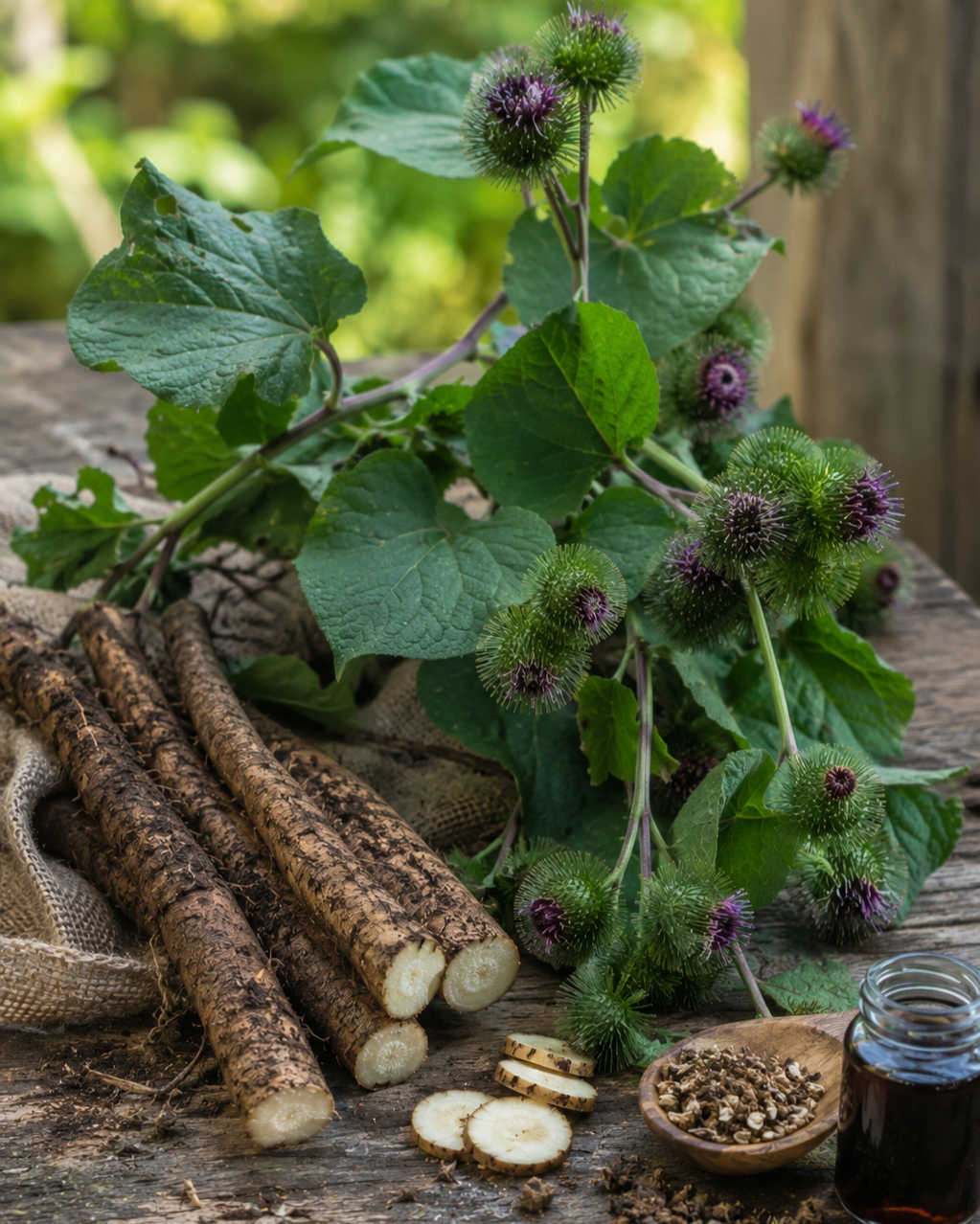
Burdock grows roadsides, field edges, abandoned lots, and forgotten places, sending a thick taproot deep into the earth while great heart-shaped leaves gather sunlight above. Hooked burs cling stubbornly to clothing and fur, making children laugh, gardeners sigh, and providing the inspiration for the invention of Velcro.
Burdock's burs cling with remarkable determination. This seems to reveal something about the plant's deeper nature. Above ground, the burs catch tenaciously to whatever they encounter, carrying the plant into new places. Beneath the soil, Burdock has been studied for its ability to accumulate environmental pollutants, helping reclaim disturbed ground. Within the body it has long been valued for binding, carrying, and helping eliminate substances that no longer belong. Whether restoring damaged landscapes or supporting the body's own pathways of detoxification, Burdock seems drawn to the work of clearing the way for new life.
For centuries, herbalists across Europe, Asia, and North America have regarded Burdock as one of the great restorative medicines. Burdock has been called into action as a blood purifier, an alterative, a liver tonic, a lymphatic, a kidney ally, and a skin herb. It has been used to support detoxification, healthy liver function, balanced digestion, clear skin, resilient immunity, and the steady elimination of metabolic waste. Each of these names describes something Burdock does. None fully captures what Burdock offers.
Burdock is, in every sense, a master plant of restoration. I also tend to think of Burdock as a plant of integration. Rather than addressing one organ or one symptom in isolation, Burdock nourishes the body's interconnected systems...the liver, kidneys, lymphatic system, bowel, skin, and microbiome...helping them work together as they were designed to. Restoration is not simply the absence of disease. It requires the return of healthy relationship between the systems that sustain life. Burdock supports the conditions from which that integration naturally arises.
This deeper understanding changes the way we think about "detoxification." I don't believe it is supportive to think of our bodies or our blood as "dirty” or “toxic”. But modern life does place an extraordinary toxic burden on them. Burdock strengthens the organs responsible for transformation and elimination, helping them better perform the remarkable work of elimination, renewal, and balance for which they were designed. When these systems become healthier, the body naturally begins releasing what it no longer needs while holding onto what truly nourishes life. In this way, Burdock is a plant of flow, restoring the healthy movement of bile, lymph, blood, nourishment, and elimination upon which vitality depends.
This is why Burdock's influence reaches so many seemingly unrelated conditions. Healthy bile flow supports digestion and the absorption of fats and fat-soluble nutrients. A thriving microbiome shapes immunity, hormone metabolism, and inflammation. Efficient lymphatic circulation clears cellular waste while nourishing tissues. Well-supported kidneys and bowels reduce the burden placed on the skin, allowing chronic eruptions to quiet from the inside out. Rather than chasing symptoms, Burdock strengthens the terrain from which health emerges.
In a culture captivated by quick fixes and dramatic interventions, Burdock offers another way. The plant works patiently, steadily, and often invisibly at first, much like the great root growing beneath the soil. Long before a Burdock plant sends up its towering flowering stalk, it has spent an entire season anchoring itself deep within the earth, gathering nourishment and storing strength. Its medicine follows the same pattern. Lasting transformation begins beneath the surface, rooted deeply, nourished patiently, and carried steadily until strength returns from the inside out.
This is why Burdock has been honored for centuries as a plant of protection, endurance, and quiet courage. Often, true healing is about restoring the conditions that allow us to become fully ourselves again.
How To Work With This Ally
Burdock is one of those wonderful, medicinal plants that moves effortlessly between the kitchen and the apothecary. Across Asia, Europe, and North America, it has been eaten as a nourishing root vegetable, simmered into long decoctions, infused into vinegars, extracted into tinctures, and applied externally to soothe the skin. This dual identity as both food and medicine reveals something important about Burdock's character. Burdock nourishes the body patiently, restoring strength through consistent relationship.
For deep constitutional support, the root is the primary medicine. Long decoctions, daily tinctures, and regular culinary use encourage the gradual restoration of healthy liver function, lymphatic movement, digestion, elimination, and metabolic balance. Burdock rewards consistency. Many herbalists have observed that its greatest gifts emerge after weeks or months of regular use, particularly in long-standing conditions involving the skin, joints, hormones, digestion, or chronic inflammation.
Different parts of the plant offer different medicines. The root serves as Burdock's deep restorative, nourishing the body's foundations and supporting long-term change. The seed has a stronger affinity for the kidneys and urinary system and has traditionally been used when fluid movement, skin eruptions, or inflammatory heat require more immediate support. The fresh leaves have long been valued externally as cooling poultices for irritated, inflamed, or injured tissues. Together, the root, seed, and leaf reveal a remarkably complete medicine, each expressing a different aspect of the same plant's intelligence.
Burdock does its best work in community. Herbalists usually pair it with other plants whose strengths complement its own. Dandelion root and Yellow Dock often accompany Burdock in alterative formulas that support liver function and elimination. Nettle and Red Clover deepen its nourishing and restorative qualities, while Ginger improves circulation and encourages movement through the tissues. Echinacea is a classic companion when additional lymphatic support is desired. Burdock seems to amplify the work of the entire formula, reminding us that healing, like nature itself, is built through cooperation.
Because Burdock nourishes the body's systems of elimination, skin conditions occasionally become more active before they improve. This is another reason to use partner herbs that support the body's organs and pathways of elimination. The skin is the body's largest organ, but when it becomes a primary pathway of elimination, it often signals that the deeper systems could use additional support. Some individuals notice temporary changes as the body's pathways of elimination become more active. Use of supportive herbs can avoid or reduce this effect. The pace of healing should always honor the individual. Burdock invites patience rather than urgency.
Perhaps the most important way to work with Burdock is simply to allow enough time for the relationship to develop. This is not a plant of quick victories. Burdock teaches us to think in seasons rather than days. Like the great taproot that spends an entire year anchoring itself beneath the earth before sending up its flowering stalk, Burdock reminds us that the deepest transformations are unfolding beneath the surface long before they become visible.
Burdock appears in Lineage, where it serves as the grounding root of the formula, nourishing deep constitutional restoration while strengthening the body for the long, slow work of deep transformation.
Plant Profile
Botanical Name
Arctium lappa
Family
Asteraceae (Daisy Family)
Common Names
Burdock, Great Burdock, Gobo, Beggar's Buttons, Hardock
Parts Used
Primarily the first-year root; seeds (fruits) and fresh leaves are also valued in traditional herbalism.
Energetics
Cooling • Moistening • Nourishing
Primary Herbal Actions
Alterative • Nutritive • Prebiotic • Hepatic • Cholagogue • Lymphatic • Detoxifying • Mild Diuretic • Anti-inflammatory • Antimicrobial • Mast Cell Stabilizer • Anti-Tumor • Chemoprotective
Key Constituents
Inulin • Lignans (including arctigenin and arctiin) • Polyacetylenes • Bitter glycosides • Flavonoids • Mucilage • Tannins • Minerals
Traditional Uses
Traditionally used to support healthy liver function, lymphatic movement, skin health, digestion, kidney function, healthy elimination, metabolic balance, joint comfort, urinary health, blood sugar regulation, and long-term constitutional restoration.
Modern Research
Modern research continues to support many of Burdock's traditional uses. Studies have demonstrated antioxidant, anti-inflammatory, antimicrobial, prebiotic, hepatoprotective, mast cell stabilizing, and metabolic-supportive activities. Research also suggests a role in supporting healthy glucose metabolism, microbiome diversity, bacterial biofilm disruption, and the modulation of inflammatory pathways. Burdock's lignans, particularly arctigenin and arctiin, have attracted growing interest in the research world for their antitumor and chemoprotective potential, including the ability to enhance the sensitivity of certain cancer cells to conventional therapies in preclinical research. Meaning, preclinical research suggests Burdock may help certain chemotherapeutic agents work more effectively and also and directly inhibit the growth of certain cancer cells.
Safety
Burdock has an excellent safety profile and is classified by the American Herbal Products Association as a Class 1 herb, indicating it can be safely consumed when used appropriately. Individuals with known allergies to plants in the Asteraceae family should use appropriate caution.
Esoteric Correspondences
Planet
Venus
Element
Water
Energy
Feminine in many Western magical traditions, though some herbalists experience Burdock as holding both masculine and feminine qualities through the balancing relationship of root and flower.
Primary Spiritual Themes
Restoration • Protection • Endurance • Rootedness • Integration • Flow • Deep Transformation
Traditional Magical Uses
Protection • Healing • Courage • Fertility • Grounding • Spiritual Cleansing
Burdock as a Spiritual Ally
Burdock teaches that true transformation begins beneath the surface. Before the flowering stalk ever rises, the plant spends an entire season driving its root deep into the earth, gathering nourishment and building unseen strength. Its medicine follows the same pattern. Lasting change is rarely instantaneous or dramatic. It is cultivated patiently, one layer at a time.
Across magical and folk traditions, Burdock has long been regarded as a protective plant. Roots were carried as amulets, placed near the home, or worn to ward away harmful influences and negativity. In Scotland, the annual Burry Man procession clothed one participant in thousands of Burdock burs, which were believed to capture misfortune and unwanted spirits before being ceremonially burned. Even the plant's hooked burs seem to mirror its medicine, catching what no longer belongs so it can eventually be released.
Matthew Wood associates Burdock with Bear medicine, a relationship reflected in the plant's very name. Derived from the Greek arktos, meaning "bear," Arctium evokes the strength, endurance, nourishment, and seasonal wisdom of this great animal. Like Bear, Burdock teaches the value of storing deep reserves, resting when necessary, and trusting the slow rhythms that sustain life over the long term.
Several modern herbalists describe Burdock as a plant that helps us reclaim our center. Karen Harrison associates Burdock with the courage to face obstacles. Robin Rose Bennett speaks of Burdock as a grandfather plant, one that transforms "worries into warriors", reflecting quiet strength built through deep nourishment rather than force. Juliet Diaz writes that Burdock holds both masculine and feminine spirits, offering balance while encouraging us to own our truth and continue growing patiently into ourselves.
Perhaps this is Burdock's greatest spiritual gift. Not to “detoxify” us, but to strengthen the foundations that allow us to become more fully ourselves.
Plant Teaching: Have the courage to become rooted enough that life can move through you.
Resources
Bennett, Robin Rose. The Gift of Healing Herbs: Plant Medicines and Home Remedies for a Vibrantly Healthy Life.
Beyerl, Paul. The Master Book of Herbalism.
Bird, Stephanie Rose. Sticks, Stones, Roots & Bones: Hoodoo, Mojo & Conjuring with Herbs.
Buhner, Stephen Harrod. Herbal Antibiotics: Natural Alternatives for Treating Drug-Resistant Bacteria.
Chevallier, Andrew. Encyclopedia of Herbal Medicine.
Diaz, Juliet. Plant Witchery: Discover the Sacred Language, Wisdom, and Magic of 200 Plants.
Dunbar, Jo. Secrets from an Herbalist's Garden: A Magical Year of Plant Remedies.
Dunwich, Gerina. Herbal Magick: A Guide to Herbal Enchantment, Folklore, and Divination.
Easley, Thomas, and Steven Horne. The Modern Herbal Dispensatory: A Medicine-Making Guide.
Garrett, J. T. The Cherokee Herbal: Native Plant Medicine from the Four Directions.
Harrison, Karen. The Herbal Alchemist's Handbook: A Complete Guide to Magical Herbs and How to Use Them.
McGuffin, Michael, Roy Upton, Annette Goldberg, et al., eds. Botanical Safety Handbook.
Stansbury, Jill. Herbal Formularies for Health Professionals, Volume 1: Digestion and Elimination.
Stansbury, Jill. Herbal Formularies for Health Professionals, Volume 3: Endocrinology.
Tierra, Michael. The Way of Herbs.
Weed, Susun S. Wise Woman Herbal: Healing Wise.
Wood, Matthew. The Earthwise Herbal, Volume I: A Complete Guide to Old World Medicinal Plants.
