Meet Calamus
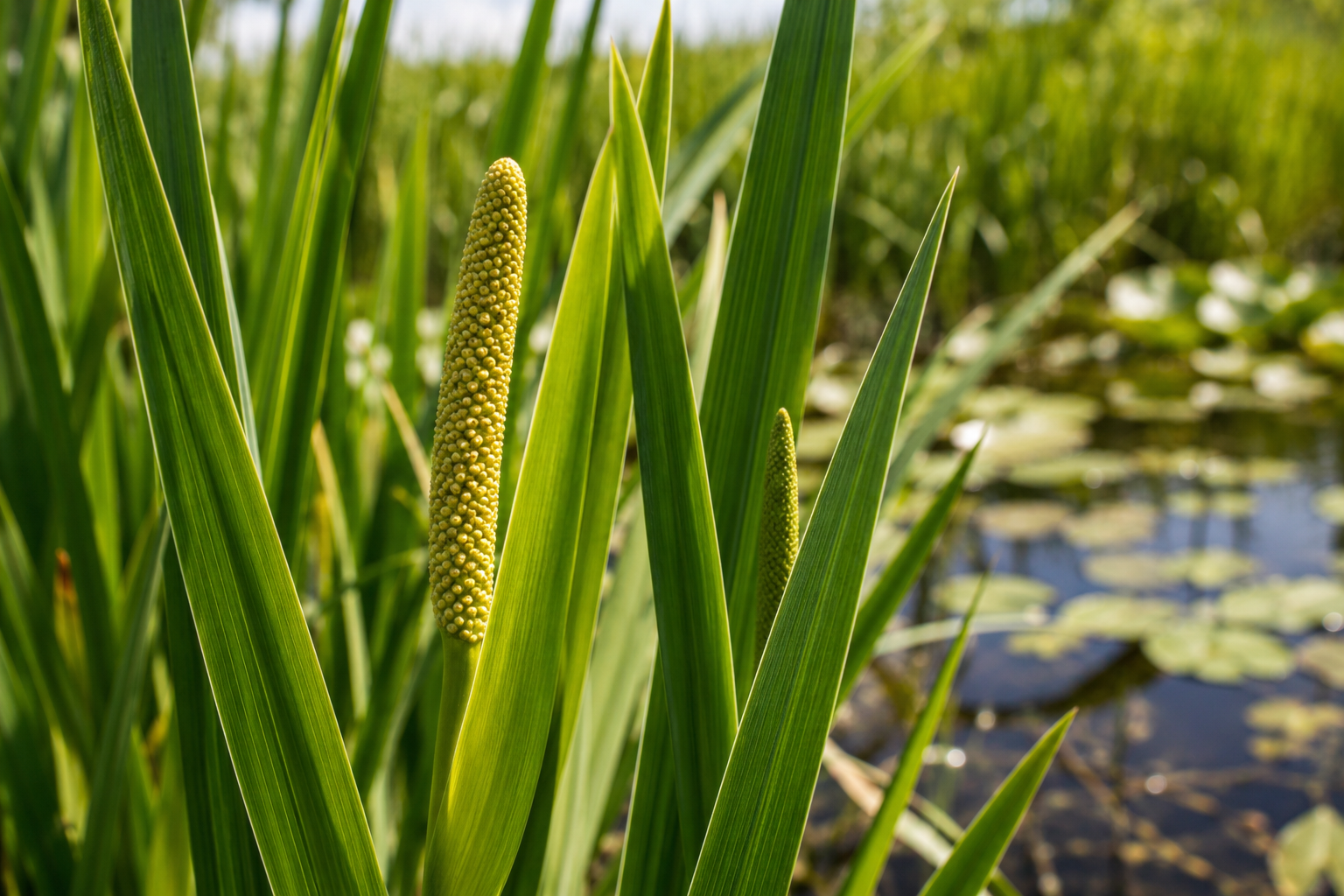
Plant Ally Profile
Acorus americanus
Attention • Discernment • Communication • Presence • Alertness
The root of discernment, clarity, and awakened attention.
Some plants sharpen our ability to perceive what is real.
Calamus, also known as Sweet Flag (Acorus americanus), belongs to this group.
Growing along the edges of marshes, streams, ponds, and wetlands, this aromatic plant has accompanied people for thousands of years. Its rhizome has been used as medicine, incense, perfume, and sacred ally in traditions stretching from India and Tibet to Europe and North America.
Calamus occupies a unique place among herbal allies.
It is both grounding and awakening.
Rooted in the earth, yet associated with heightened perception.
Ancient practitioners valued Calamus for supporting memory, speech, digestion, and mental clarity. In Ayurveda, it is known as Vacha, often translated as "speech" or "that which speaks clearly," reflecting its longstanding reputation as a plant that helps remove obstacles to clear communication and understanding.
For many Indigenous peoples of North America, Sweet Flag was a highly valued ally. Often known as Muskrat Root, it accompanied travel, ceremony, endurance, digestion, respiratory wellness, and the cultivation of alert awareness. Some researchers suggest that the medicinal form of American Sweet Flag may have been intentionally carried and propagated across the continent for generations, preserving a particularly valued lineage of medicine.
Calamus has been valued as much for its relationship with digestion as for its effects on the mind. This pairing may seem unusual at first, but traditional systems often recognized that clear perception depends upon our ability to properly receive, process, and integrate experience, whether that experience arrives as food, information, or insight.
As an aromatic, its fragrance is unmistakable. Ancient Egyptians incorporated its fragrant rhizome into perfumed oils and sacred preparations, and its warm, spicy fragrance remains valued in perfumery today.
Warm.
Bright.
Aromatic.
Alive.
Across cultures, a common thread emerges: Calamus helps clear what obscures perception so that understanding may arise.
Calamus seems to encourage a state of wakeful presence.
The ability to notice.
To listen.
To perceive.
In a world overflowing with distraction, this medicine feels increasingly relevant.
Not because it asks us to do more.
Because it reminds us to be here, now.
How To Work With This Ally
Calamus may be especially supportive during seasons that call for focus, communication, study, travel, or intentional awareness.
Traditionally, the fresh or dried rhizome has been chewed during long journeys, periods of sustained concentration, and ceremonial practice. It also lends itself beautifully to incense, ritual blends, meditation, journaling, and contemplative work.
Historically, it has been used to support memory, speech, comprehension, and mental clarity. Traditional systems associated it with awakening perception, restoring communication, and helping the mind grasp what had become difficult to understand.
Some traditions also associate Calamus with intentional dreaming and meditation, working with the plant to clarify questions carried into sleep.
I often think of Calamus as a plant of discernment.
Not discernment in the sense of judgment, but discernment in the sense of seeing clearly.
There are times in life when we become overwhelmed by noise. Too much information. Too many opinions. Too many competing demands for our attention. In those moments it becomes difficult to recognize what actually matters.
Calamus returns attention to what is essential.
For me, its teaching often feels remarkably simple:
Pay attention.
Notice what is actually here.
The next step is usually already waiting.
I am fortunate to have found Sweet Flag growing beside a pond, where I visit it often throughout the year.
Its medicine often feels like an invitation to become fully present with what is already unfolding around you.
For me, Calamus is a reminder that attention is a sacred act.
The world is speaking all the time.
All we have to do is tune in and listen.
Calamus appears in Seeker, where its clarifying nature complements herbs traditionally associated with contemplation, insight, and focused awareness.
Plant Profile
Botanical Name:Acorus americanus (American Sweet Flag)
Family: Acoraceae
Parts Used: Rhizome
Energetics: Warming • Drying • Aromatic • Bitter
Primary Actions: Aromatic stimulant • Cognitive tonic • Carminative • Digestive stimulant • Circulatory stimulant • Anti-catarrhal
Traditional Uses: Mental clarity • Memory support • Speech and communication • Digestive support • Gas and bloating • Respiratory congestion • Loss of voice • Ceremonial use • Travel support • Alertness and endurance • Discernment and focused awareness
What Modern Research Shows: Research on Calamus remains limited, though studies have identified antioxidant, anti-inflammatory, antispasmodic, and digestive-supportive properties within the rhizome. Much of the modern discussion surrounding Calamus focuses on β-asarone, a constituent found in some Eurasian varieties. Plant Alchemy works exclusively with Acorus americanus (American Sweet Flag), a North American species that contains little to no β-asarone. Traditional use, emerging research, and ethnobotanical records continue to support Calamus's longstanding reputation as a digestive tonic, nervous system ally, and plant of heightened awareness.
Notable Constituents: Volatile oils • Terpenes • Sesquiterpenes • Eugenol • Amines • Tannins • Resin • Mucilage • Gum • Starch • Acorin • Trace asarones (genotype dependent)
Plant Themes: Presence • Clarity • Alertness • Communication • Discernment • Attention • Balance
Esoteric Correspondences
☿ Mercury and ☉ Sun • Air 🜁
Awareness • Communication • Clarity • Attention • Illumination
Supporting concentration and study • Strengthening communication and self-expression • Enhancing presence and discernment • Bringing conscious awareness to daily life • Cultivating inner mastery and intentional action
Plant Teaching: Pay attention. The world is speaking all the time.
Note:* Plant Alchemy sources Acorus americanus (American Sweet Flag), a North American species traditionally used by Indigenous peoples and distinct from some Eurasian varieties of Acorus calamus that may contain higher levels of β-asarone.*
References
Diaz, J. (2020). Plant Witchery: Discover the Sacred Language, Wisdom, and Magic of 200 Plants.
McGuffin, Michael, et al. Botanical Safety Handbook
Moerman, Daniel E. Native American Ethnobotany.
Wood, Matthew. The Earthwise Herbal: A Complete Guide to New World Medicinal Plants.
USDA Plants Database. Acorus americanus (American Sweet Flag).
Owen, M.D., et al. Research concerning β-asarone content and phytochemical differences between Acorus americanus and Eurasian Acorus calamus varieties.
This profile reflects both traditional herbal knowledge and modern scientific understanding. It is intended for educational purposes and should not replace individualized medical advice. As with all herbal medicines, consider the whole person, their health history, and appropriate safety precautions before use.
