Meet Gotu Kola
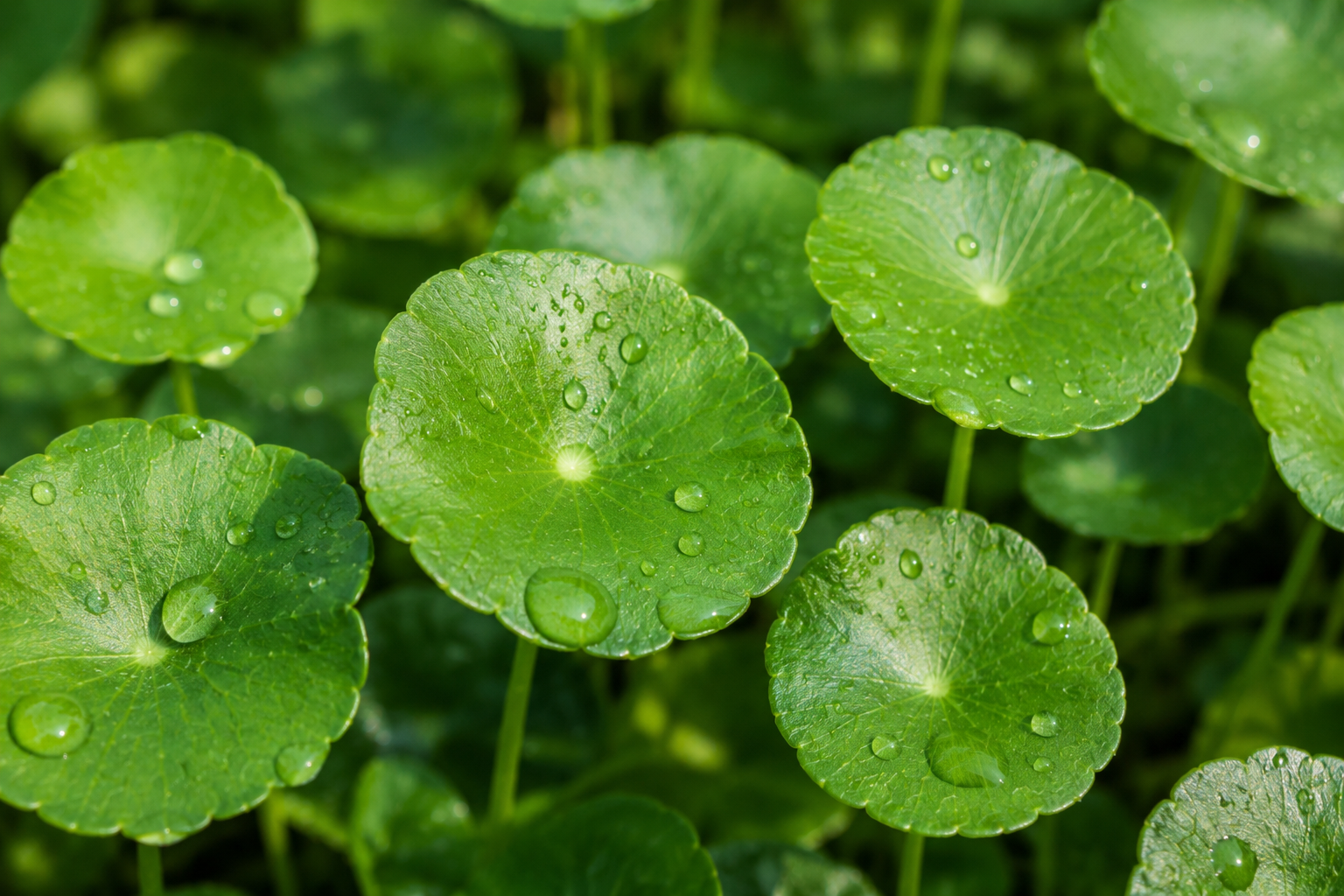
Plant Ally Profile
Centella asiatica
Mental Clarity • Memory • Focus • Wisdom • Learning
An herb of clarity, wisdom, and long remembrance.
Some plants teach us how to pay attention.
Gotu Kola (Centella asiatica) belongs to this group.
Growing close to the earth in damp meadows, rice paddies, and waterways throughout Asia, Gotu Kola has been revered for thousands of years as a plant of longevity, mental clarity, and spiritual cultivation. It occupies a unique place in traditional systems of medicine, where it has been used to support cognition, healthy aging, tissue repair, and contemplative practice.
In Ayurveda, it is known as a rasayana, a rejuvenating herb believed to nourish both body and mind. In Traditional Chinese Medicine, it is valued for its cooling, restorative qualities.
Traditionally, Gotu Kola has been valued not only for mental clarity, but also for its ability to support healing, longevity, healthy circulation, and the gradual restoration of vitality. Its reputation as a rejuvenating herb reflects a broader understanding that true cognition depends upon the health of the whole person.
Legends tell of sages and yogis consuming Gotu Kola to support meditation and extend vitality. Literal or symbolic, these stories speak to the plant's enduring association with wisdom, concentration, and the steady cultivation of awareness.
The more I learn about Gotu Kola, the more I notice a recurring pattern in her medicine.
Across traditional use and modern research alike, she appears wherever repair is needed.
She has been used to support the regeneration of skin, blood vessels, connective tissues, mucous membranes, and nervous tissue. She is valued in traditions that seek to restore strength after illness, injury, depletion, and long periods of stress.
In this way, Gotu Kola teaches something deeper than concentration.
She teaches integrity.
The body remembers how to heal.
The mind remembers how to learn.
The spirit remembers how to grow.
Sometimes all three simply need the proper conditions in which to do so.
Unlike herbs that stimulate through force or intensity, Gotu Kola tends to work differently.
Its medicine feels grounded. Patient. Steady.
Rather than scattering attention outward, it seems to gather it inward.
It encourages focus without tension. Presence without urgency. Clarity without agitation.
In a culture that rewards constant reaction, Gotu Kola reminds us of a quieter kind of intelligence.
The kind that develops through observation.
The kind that grows through practice.
The kind that remembers.
How To Work With This Ally
Gotu Kola may be especially supportive during seasons of learning, contemplation, creative work, and intentional self-development.
I often reach for it during periods that require sustained focus or when I am trying to balance mental effort with nervous system resilience. It pairs beautifully with journaling, study, meditation, and reflective practices that benefit from steady attention.
Gotu Kola also finds its way into a few of my signature skin support and wound healing formulations, where its longstanding reputation for supporting healthy tissue renewal, collagen formation, and resilient skin aligns beautifully with both traditional use and modern research.
I included her in a formula created to support healing after my son suffered a severe injury to his ear following a dog bite. Bite doesn't cover it — his ear was mangled. Cartilage has limited blood supply and can heal slowly, often leaving significant scar tissue. After an ED visit, stitches, and pharmaceutical antibiotics, it was not looking good. After two days of wound care with the wound formula, it was turning in the right direction. After four days, I could see that it would heal well.
While no herb can guarantee a particular outcome, the healing process was remarkable and left no visible scar. None.
Experiences like this remind me that some plants seem to possess a particular affinity for helping the body remember what it already knows how to do.
Gotu Kola has become one of the plants I reach for whenever restoration, rebuilding, and connective tissue integrity are part of the goal.
Gotu Kola is a teacher that reminds us that meaningful growth often occurs gradually, beneath the surface, long before it becomes visible. I see her as an herb of integration, slowly knitting together the disparate pieces of things.
Its gifts tend to reveal themselves over time. Not through intensity, through consistency.
For me, Gotu Kola is a reminder that wisdom is rarely a sudden event. More often, it is the accumulation of countless moments of focused attention. Gotu Kola teaches what happens when attention becomes a lifelong practice.
Gotu Kola is featured in Seeker, where it contributes its longstanding reputation for supporting concentration, learning, and sustained attention.
Plant Profile
Botanical Name:Centella asiatica
Family: Apiaceae (Carrot Family)
Parts Used: Aerial parts
Energetics: Cooling • Slightly drying
Primary Actions: Adaptogen • Cognitive tonic • Nervine Trophorestorative • Rasayana (Rejuvenative Tonic) • Vulnerary • Connective Tissue Restorative • Circulatory Tonic • Peripheral Vasodilator • Alterative • Longevity Tonic
Traditional Uses: Cognitive support • Memory and concentration • Meditation and contemplative practice • Healthy aging and longevity • Nervous system restoration • Recovery from mental fatigue • Connective tissue support • Wound healing support • Scar and keloid prevention support • Mucosal membrane restoration • Digestive tract support • Healthy circulation • Venous insufficiency support • Convalescence and recovery support • Tissue regeneration support
Notable Constituents: Triterpenoid saponins (asiaticoside, asiatic acid, madecassoside, madecassic acid) • Flavonoids • Polyphenols • Terpenoids • Sterols • Tannins • Volatile compounds
What Modern Research Shows: Research supports Gotu Kola's traditional use as both a cognitive and restorative tonic. Studies have demonstrated benefits for wound healing, collagen formation, vascular repair, and healthy circulation. Clinical research has also explored its ability to support attention, working memory, mood, and anxiety resilience. Emerging evidence suggests Gotu Kola may help support healthy nervous system function, connective tissue integrity, and age-related cognitive health.
Safety: Classified as AHPA Botanical Safety Handbook Class 1 (herbs that can be safely consumed when used appropriately). May occasionally cause drowsiness in some individuals and is traditionally taken earlier in the day.
Plant Themes: Clarity • Wisdom • Regeneration • Restoration • Integrity • Longevity • Cultivation • Steady Growth
Esoteric Correspondences
☿ Mercury and ♃ Jupiter • Air 🜁
Mental Clarity • Learning • Discernment • Wisdom • Expansion
Mental Clarity • Learning • Discernment • Wisdom • Expansion • Meditation • Concentration • Contemplation • Integration of Knowledge
Plant Teaching:Wisdom grows the way roots grow. Quietly, steadily, and often unseen until the moment it is needed.
References
Chevallier, Andrew. The Encyclopedia of Herbal Medicine
Cunningham, Scott. Cunningham's Encyclopedia of Magical Herbs
McGuffin, Michael, et al. Botanical Safety Handbook
Stansbury, Jill. Herbal Formularies for Health Professionals, Volume 1: Digestion and Elimination
Thomas Easley & Steven Horne. The Modern Herbal Dispensatory
Wood, Matthew. The Earthwise Herbal, Volume I: A Complete Guide to Old World Medicinal Plants
This profile reflects both traditional herbal knowledge and modern scientific understanding. It is intended for educational purposes and should not replace individualized medical advice. As with all herbal medicines, consider the whole person, their health history, and appropriate safety precautions before use.
