Meet California Poppy
Plant Ally Profile
Eschscholzia californica
Sleep • Release • Comfort • Dreaming • Ease
The flower of release, comfort, and gentle relief.
California Poppy teaches us the wisdom of rhythm.
When to bloom and when to rest. How to trust that both are necessary.
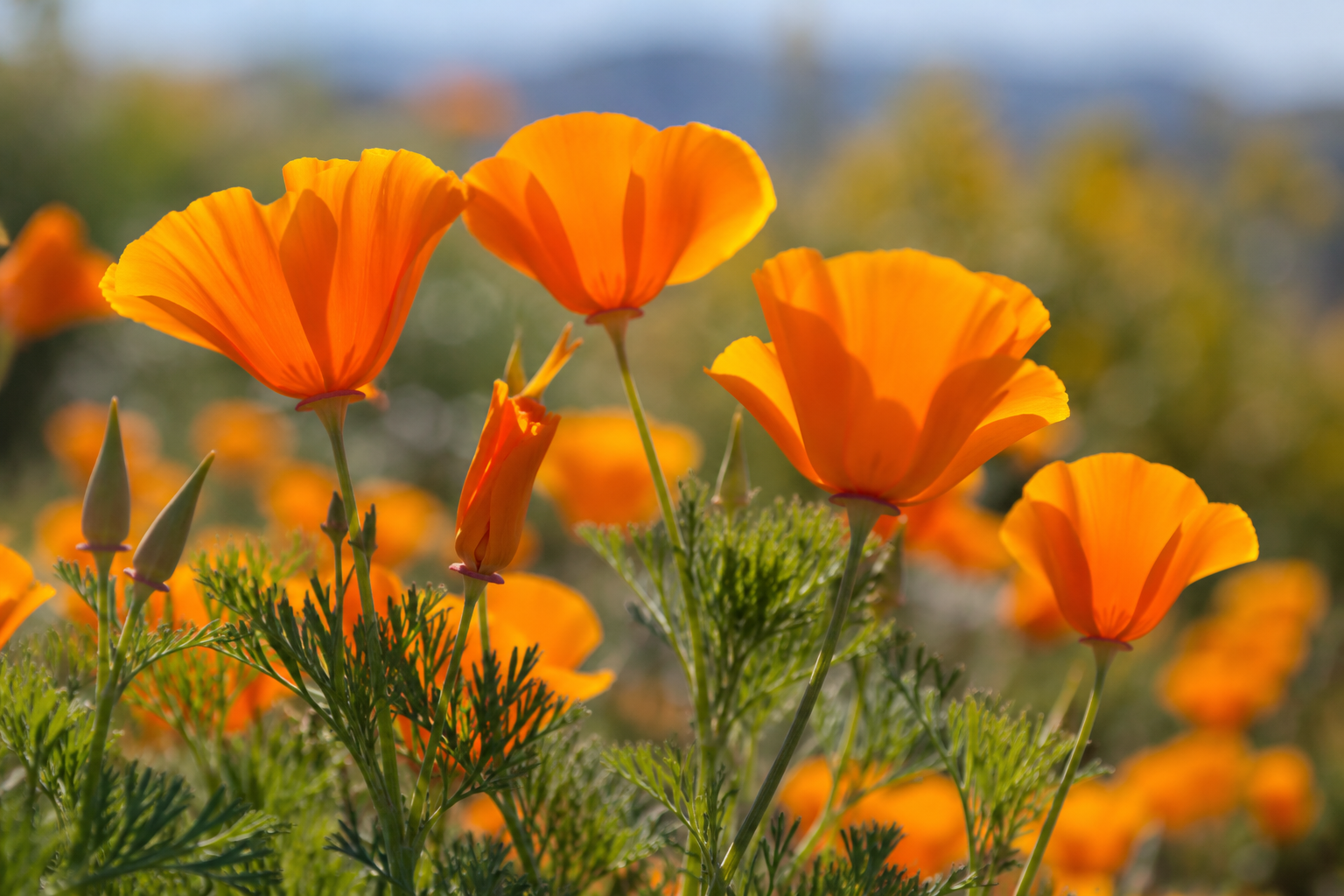
With her luminous orange blossoms opening to the sun and closing again with dusk, California Poppy embodies the rhythm of engagement and withdrawal, activity and rest. She blooms fully when conditions are right and folds inward when darkness comes, reminding us that both expression and restoration have their place.
Native to the western regions of North America, she has long been treasured for her ability to calm tension, support sleep, and ease the discomfort that accumulates when the body has been holding on for too long.
More than a sleep herb, California Poppy is a plant of transition.
She appears whenever the nervous system struggles to move from one state into another. From activity into rest. From tension into ease. From vigilance into trust. From wakefulness into sleep.
Many people who say they cannot sleep are really just unable to cross the threshold. Their bodies are tired, but the mind continues to move. Their muscles are ready for rest, but the nervous system remains alert.
California Poppy specializes in this crossing. Rather than forcing sleep, she helps create the conditions that allow rest to arrive naturally.
Unlike stronger sedatives, California Poppy's medicine is remarkably gentle.
She invites a loosening of tension. A softening of resistance. A willingness to stop carrying what no longer needs to be carried.
Though she belongs to the same family as the opium poppy, her effects are remarkably different. California Poppy is not considered narcotic and has long been valued as a calming remedy suitable for children. Rather than overwhelming the nervous system or forcing sedation, she appears to encourage balance, helping the body remember how to relax when relaxation has become difficult.
For this reason, I often think of her medicine as permission rather than force. She does not push the body toward rest. She invites it.
Her medicine is especially beloved by those who struggle to transition from activity into rest. Those who find themselves exhausted yet unable to fully settle.
She is equally at home when physical discomfort is part of the story, offering support when pain, tension, or bodily unease make restorative sleep difficult to find.
California Poppy meets us in that space between holding on and letting go.
In a culture that teaches us to push through, she offers another possibility.
Ease.
How To Work With This Ally
California Poppy may be especially supportive during seasons of restlessness, physical tension, stress-related sleep difficulties, and periods when the nervous system is struggling to downshift.
I often reach for her when the body feels tight, uncomfortable, wired, or unable to fully relax. I find she is especially helpful when physical discomfort is contributing to restless nights, making it difficult for the body to settle into restorative sleep.
Pain can make it difficult to rest. Lack of rest can increase sensitivity to discomfort. Over time, the nervous system may become caught in a cycle of tension, vigilance, and exhaustion.
California Poppy meets this intersection with remarkable grace. By helping the body soften, release, and settle, she often supports both comfort and rest at the same time. In this way, her medicine is not only about sleep. It is about helping the nervous system remember what ease feels like.
She pairs beautifully with evening rituals, sleep support formulas, and moments when comfort itself becomes medicine.
Her gift is permission.
Permission to release unnecessary tension. Permission to soften. Permission to rest.
While California Poppy is traditionally associated with lunar and Venusian qualities of rest, comfort, and emotional ease, I have also come to see her as a teacher of the relationship between Sun and Moon, between expression and restoration.
Her brilliant blossoms open fully to the light of day and fold inward again with the coming of darkness. This is not merely symbolism projected onto the plant. It is part of how she lives.
California Poppy demonstrates that there is a season for engagement and a season for withdrawal. A time to bloom and a time to fold inward. A time to participate fully in the world and a time to retreat into restoration.
Many of us have learned how to keep blooming long after our reserves have been depleted. California Poppy reminds us that health depends not only upon our ability to show up, but also upon our willingness to rest. Both are necessary. Both belong to the cycle.
California Poppy is featured in Deep Zone, where she works alongside Skullcap and Passionflower to support relaxation, nervous system restoration, and restorative sleep.
Plant Profile
Botanical Name:Eschscholzia californica
Family: Papaveraceae (Poppy Family)
Parts Used: Aerial Parts
Energetics: Cooling • Relaxing • Slightly Drying
Primary Actions: Nervine • Sedative • Mild Hypnotic • Anxiolytic • Antispasmodic • Analgesic
Traditional Uses: Sleep Support • Nervous Tension • Anxiety • Stress-Related Restlessness • Difficulty Transitioning Into Sleep • Bedwetting • Muscular Tension • Tension-Related Discomfort • Physical Discomfort Affecting Sleep • Restless Children
Notable Constituents: Isoquinoline Alkaloids (including Protopine, Cryptopine, and Calyadenine) • Flavonoids • Flavon Glycosides • Carotenoids
What Modern Research Shows: Research suggests California Poppy helps normalize nervous system function, supporting healthy responses to stress, nervous tension, discomfort, and occasional sleeplessness. Studies indicate an affinity for GABA receptors within the brain, helping calm mental activity and promote relaxation without significantly depressing central nervous system function.
Safety: AHPA Class 2B (not for use during pregnancy).
Plant Themes: Release • Comfort • Ease • Rest • Softening
Esoteric Correspondences
☽ Moon and ♀ Venus • Water 🜄
Rest • Comfort • Emotional Ease • Receptivity • Dreaming
Supporting sleep and dreamwork • Easing emotional and physical tension • Encouraging relaxation • Cultivating gentleness and self-compassion
Plant Teaching:Bloom when the energy is present. Rest when the darkness falls. Both are part of the cycle.
References
American Herbal Products Association. Botanical Safety Handbook, 2nd ed.
Chevallier, Andrew. Encyclopedia of Herbal Medicine.
Dunbar, Joe. Secrets from an Herbalist's Garden.
Easley, Thomas & Horne, Steven. The Modern Herbal Dispensatory.
Rose, Robin. The Gift of Healing Herbs.
Wood, Matthew. The Earthwise Herbal, Volume II: A Complete Guide to New World Medicinal Plants.
This profile reflects both traditional herbal knowledge and modern scientific understanding. It is intended for educational purposes and should not replace individualized medical advice. As with all herbal medicines, consider the whole person, their health history, and appropriate safety precautions before use.
