Meet Passionflower
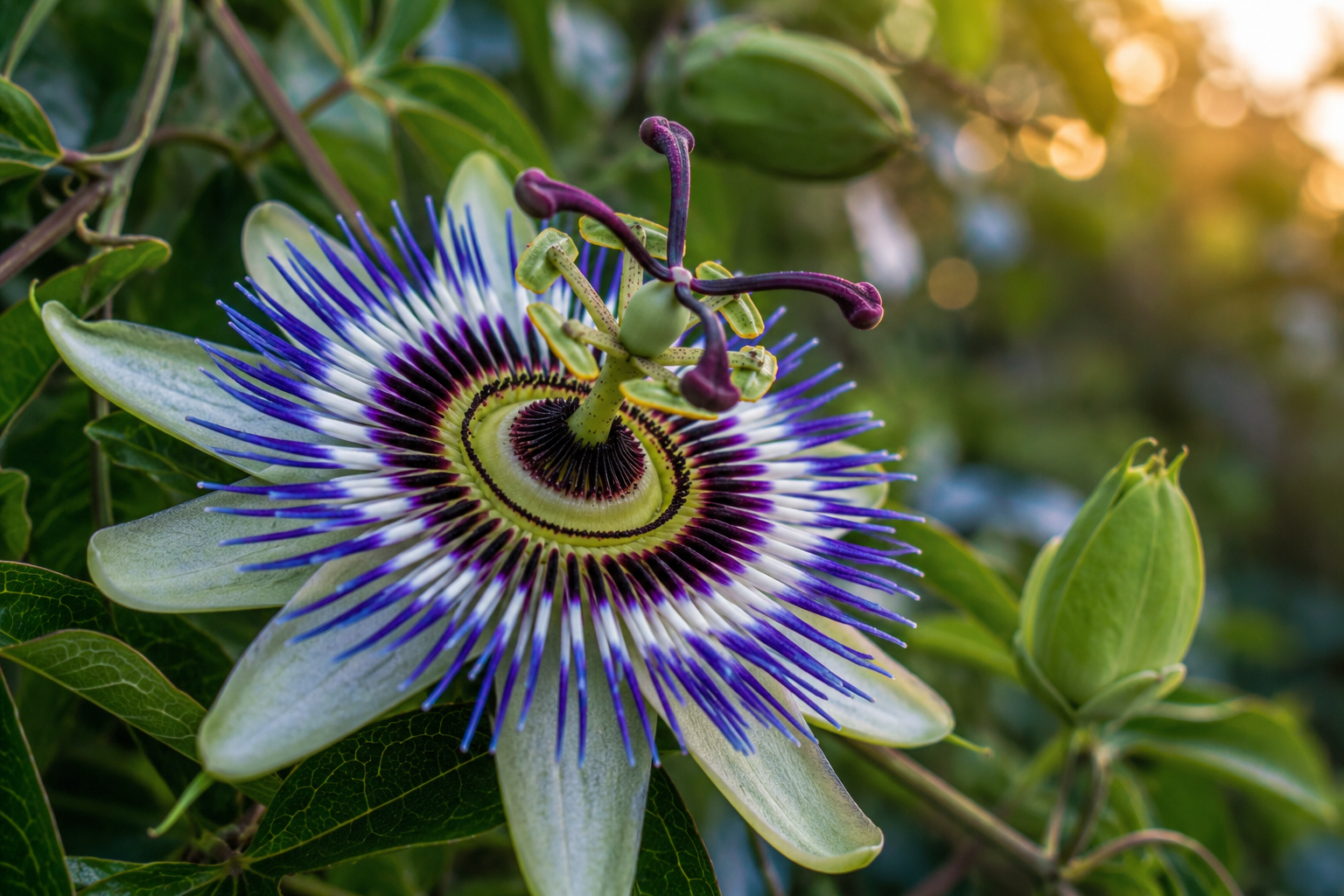
Plant Ally Profile
Passiflora incarnata
Sleep • Restlessness • Rumination • Surrender • Peace
The vine of surrender, trust, and peaceful rest.
Passionflower teaches us to let go.
This graceful climbing vine, with her intricate flowers and wandering tendrils, has long been valued for the ability to calm an overactive mind and ease the tension that accumulates when thoughts refuse to settle.
Native to the Americas, Passionflower has been used for centuries to support rest, nervous system regulation, and emotional balance. Its medicine is especially beloved by those whose exhaustion begins in the mind.
Passionflower received its common name from early Christian missionaries who saw symbolic representations of the Passion of Christ within the flower's intricate structure. The corona was said to resemble the crown of thorns, while other floral parts were associated with the wounds and instruments of the crucifixion.
Whether viewed as religious symbolism or simply botanical folklore, the association is striking. Across traditions, Passionflower has become linked with surrender, peace, trust, and the willingness to place one's burdens down for a time.
Passionflower is often thought of as a sleep herb, but I have come to see her as a plant of surrender.
She does not force sleep. She quiets the activity that prevents sleep from arriving naturally.
Passionflower is for the mind that continues working long after the day is done. The planning. The reviewing. The rehearsing of conversations. The endless search for solutions to problems that cannot be solved at two o'clock in the morning.
She reminds us that vigilance is not the same thing as safety.
Some things can wait until tomorrow. Some things are allowed to remain unfinished.
Rest is not something we earn by exhausting ourselves completely. It is a biological need and a form of trust.
Passionflower meets us there.
She gently loosens the grip of mental activity and invites the nervous system into a state of greater ease.
Her medicine feels like surrender. The willingness to set something down, if only for a little while.
In a culture that prizes constant productivity, Passionflower reminds us that rest is not something we earn.
It is something we require.
How To Work With This Ally
Passionflower may be especially supportive during seasons of stress, rumination, restlessness, and difficulty unwinding at the end of the day.
I often reach for her when the body is tired but the mind continues racing. She pairs beautifully with evening rituals, sleep support formulas, meditation, journaling, and practices that encourage release rather than effort.
While Passionflower is most often associated with sleep, I frequently think of her as a remedy for overstimulation.
I reach for her when the nervous system feels unable to disengage. When thoughts loop endlessly. When stress begins showing up in the body as tension, tightness, digestive discomfort, muscle tension, headaches, or difficulty settling into rest.
She is particularly helpful for the tired-but-wired state that so many people experience during periods of prolonged stress. The body is exhausted, but the mind continues moving.
Passionflower reminds us that we do not have to carry every thought to its conclusion.
Her medicine often feels like an invitation to loosen your grip and rest.
Passionflower is featured in Deep Zone, working alongside Skullcap and California Poppy, to support relaxation, nervous system recovery, and restorative sleep.
Plant Profile
Botanical Name:Passiflora incarnata
Family: Passifloraceae
Parts Used: Aerial parts
Energetics: Cooling, relaxing
Primary Actions: Nervine, relaxant, sedative, antispasmodic, tranquilizing
Traditional Uses: Anxiety, restlessness, insomnia, rumination, nervous tension, muscular tension, muscle spasms, stress-related sleep disturbance
What Modern Research Shows: Research supports Passionflower's traditional use for anxiety, nervous tension, restlessness, and sleep support. Clinical studies have found Passionflower to be comparable to certain conventional anti-anxiety medications for reducing anxiety, while producing fewer reported side effects. Additional research suggests benefits for subjective sleep quality and supports Passionflower's longstanding reputation as a gentle calming and sleep-supportive herb.
Safety: Class 1 (Botanical Safety Handbook), generally recognized as safe when used appropriately. Matthew Wood notes occasional paradoxical excitement and vomiting in children under four years of age with large doses. Otherwise widely regarded as a gentle and well-tolerated nervine.
Notable Constituents: Flavonoids, amino acids, cyanogenic glycosides, maltol, alkaloids (reported), glycosides
Plant Themes: Surrender • Trust • Rest • Release • Peace
Esoteric Correspondences
☽ Moon and ♀ Venus • Water 🜄
Peace • Receptivity • Emotional Ease • Rest • Surrender
Supporting sleep and dreamwork • Calming mental overactivity • Encouraging emotional release • Cultivating trust and inner peace
Plant Teaching: You do not have to solve everything tonight.
References
Beyerl, Paul. The Master Book of Herbalism.
Chevallier, Andrew. Encyclopedia of Herbal Medicine.
Dunwich, Gerina. Herbal Magick.
Cunningham, Scott. Encyclopedia of Magical Herbs.
Easley, Thomas & Horne, Steven. The Modern Herbal Dispensatory.
Grieve, M. A Modern Herbal.
Harrison, Karen. The Herbal Alchemist's Handbook.
McGuffin, Michael et al. Botanical Safety Handbook.
Stansbury, Jill. Herbal Formularies for Health Professionals, Volume 1: Digestion and Elimination.
Weed, Susun. Wise Woman Herbal for the Childbearing Year.
Wood, Matthew. The Earthwise Herbal, Volume II: A Complete Guide to New World Medicinal Plants.
This profile reflects both traditional herbal knowledge and modern scientific understanding. It is intended for educational purposes and should not replace individualized medical advice. As with all herbal medicines, consider the whole person, their health history, and appropriate safety precautions before use.
