Meet Dandelion
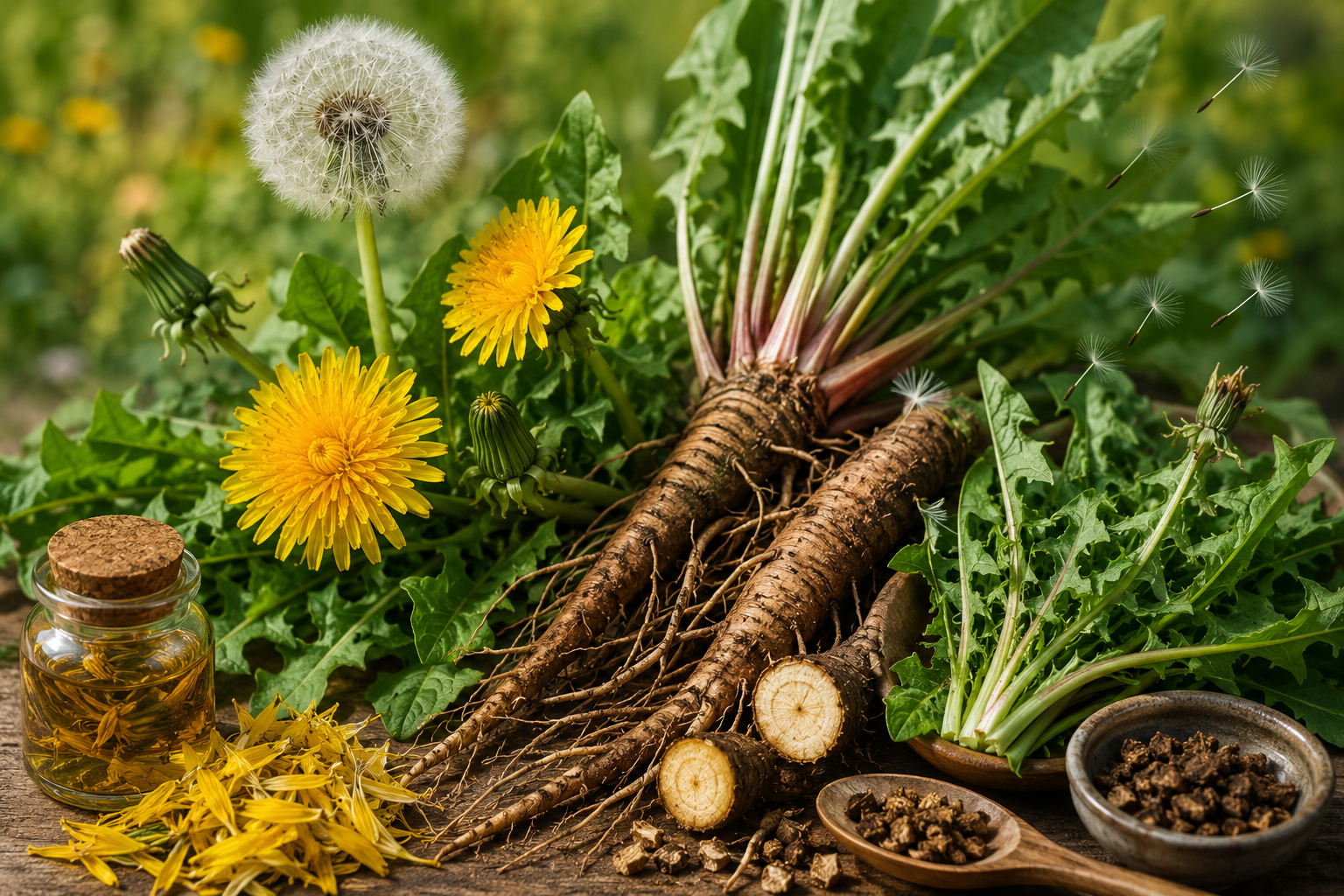
Plant Profile
Taraxacum officinale
Renewal • Flow • Nourishment • Resilience • Generosity
The faithful companion who restores movement.
Few plants have been so deeply loved, so widely used, and so thoroughly misunderstood as Dandelion. Today it is dismissed as a weed, sprayed from lawns, and pulled from gardens. Yet for centuries it has nourished people as food, restored health as medicine, fed pollinators after the long winter, healed depleted soils, and quietly accompanied humanity wherever we have settled. It does not hide in distant mountains or ancient forests. It grows at our feet, as if reminding us that some of nature's greatest gifts are also its most generous.
There is an old habit of searching for healing in the rare and exotic while overlooking the abundance surrounding us. Dandelion gently challenges that assumption. It is one of the world's great common medicines, flourishing in meadows, orchards, sidewalks, vacant lots, and backyards across the globe. Herbalists from Europe, North America, China, and beyond have all reached remarkably similar conclusions about this humble plant. Collectively, they describe an ally that nourishes while it clears, strengthens while it restores, and encourages the body to return to its own healthy rhythms.
Dandelion's medicine is movement and it teaches through the way it lives.
Its deep taproot penetrates compacted soils, creating channels for water and air while drawing minerals from deep beneath the earth and returning them to the surface. It is among nature's first responders, restoring disturbed ground, feeding earthworms, supporting healthy soil biology, and preparing the way for other plants to thrive. In biodynamic agriculture, Dandelion is one of the six compost preparations valued for its role in mineral balance and soil vitality.
Above ground, its bright flowers are among the earliest and most important nectar and pollen sources for bees and other pollinating insects. More than ninety species of insects have been observed visiting its blossoms, while birds and mammals readily consume its seeds and leaves. Even after flowering, the familiar white seed globe entrusts thousands of seeds to the wind, ensuring that life continues in new places.
Remarkably, these ecological gifts mirror Dandelion's traditional medicinal actions. Just as it loosens compacted soil, restores drainage, and brings hidden minerals to the surface, Dandelion has long been valued for restoring healthy movement of bile, digestive secretions, lymph, blood, and metabolic waste while replenishing the body's own mineral reserves.
Whether healing disturbed landscapes or supporting healthy physiology, Dandelion seems drawn to the work of restoration.Those same themes echo through its traditional medicinal uses. Dandelion has long been valued for restoring the healthy movement of bile, digestive secretions, lymph, blood, urine, and metabolic waste. It gently supports the organs responsible for nourishment, elimination, and renewal, helping healthy physiology reassert itself.
Perhaps this is why nearly every part of the plant has found its place in traditional herbalism. The root strengthens the liver, digestion, and gut microbiome. The mineral-rich leaves nourish the kidneys while providing one of nature's most balanced diuretics. The cheerful golden flowers have long been cherished for supporting the heart, lifting the spirits, easing tension, and brightening both skin and mood. Even the milky white latex has been valued for generations as a remedy for stubborn warts and other minor skin complaints.
In The Cherokee Herbal, J. T. Garrett associates Dandelion with the East, West, and North directions, reflecting the plant's remarkably broad role in traditional Cherokee healing. In the East, Dandelion is a medicine of renewal and vitality, used to strengthen women after childbirth and support the heart. In the West, it is a cleansing ally that restores healthy liver function, promotes bile flow, eases fluid retention, and supports the body's natural elimination pathways. In the North, it becomes a strengthening and calming medicine, with teas prepared from the leaves and roots to nourish the nerves and restore resilience. Together, these three directions portray Dandelion as a plant that renews, restores, and strengthens the whole person.
Yet Dandelion's greatest lesson may not be medicinal at all.
Every spring, after cold and darkness have passed, countless small suns rise from the earth. They feed bees when little else is blooming. They nourish wildlife. They restore damaged soils. They offer themselves freely as food and medicine. Then, when their work is complete, they surrender to the wind, scattering thousands of seeds that carry life into new places.
Dandelion reminds us that the world has been trying to care for us all along. Sometimes the medicines we need most are not hidden in distant places. They are waiting patiently in our own backyard.
How to Work With This Ally
Dandelion is one of the medicinal plants whose entire being offers something of value. Root, leaf, flower, and even the milky sap each express a different facet of the plant's generous nature. Learning these differences transforms Dandelion from a familiar weed into an extraordinarily versatile ally.
The root reaches deepest, both in the soil and in the body. Rich in bitter compounds and inulin, it encourages healthy digestive secretions, supports bile production, nourishes the liver, and feeds beneficial gut microbes. It is particularly well suited to times of sluggish digestion, liver congestion, seasonal transition, or whenever the body seems burdened by stagnation. Enjoy it as a decoction, tincture, or roasted tea, though the unroasted root retains its full complement of bitters.
The leaves are among nature's finest food medicines. Packed with minerals, vitamins, and phytonutrients, they gently support kidney function while helping maintain healthy fluid balance without depleting potassium. Young spring leaves are delicious in salads, while older leaves can be lightly steamed, sautéed, blended into soups, infused as tea, or prepared as mineral-rich vinegars. They are ideal for long-term nourishment and are especially appropriate during spring renewal.
The flowers bring a different kind of medicine. Their cheerful golden blossoms have been infused into oils for sore muscles, stiff joints, tender bellies, and irritated skin. Herbalists have also associated the flowers with the heart, emotional ease, and the bright blooms are known for lifting heavy spirits. Fresh blossoms brighten salads, syrups, wines, fritters, and vinegars, reminding us that beauty itself can be nourishing.
The milky white sap hidden within the stems can be applied directly to warts, corns, and calluses, where we can rely upon its gentle keratolytic action.
Perhaps the most beautiful way to work with Dandelion is not through any single preparation, but through relationship. Gather the tender leaves in spring. Pause beside the flowers as the bees arrive. Dig the roots in autumn after the plant has drawn its energy back into the earth-held parts. Watch the white seed globe surrender itself to the wind. Over time, Dandelion becomes less of a remedy and more of a seasonal companion, quietly reminding us that healing is often an exercise in restoring the steady flow of life itself.
Plant Profile
Botanical Name:Taraxacum officinale F.H.Wigg. (and other Taraxacum species are used similarly throughout the world)
Family: Asteraceae (Sunflower Family)
Common & Folk Names: Blowball • Bitterwort • Clock Flower • Lion's Tooth • Priest's Crown • Pissenlit • Wet-a-bed • White Endive • Wild Endive • Yellow Flower • Yellow Drifter • Tell Time • Puffball • Cankerwort • Fortune Teller • Irish Daisy • Dune Head Clock • Red-Seeded Dandelion • Arctic Dandelion • Dent-de-Lion
Parts Used:
Root • Leaf • Flower • Fresh Latex (sap)
Energetics:
Cooling • Bitter • Drying • Nutritive • Restorative
Primary Actions
Root: Alterative • Hepatic • Cholagogue • Bitter Digestive • Stomachic • Prebiotic • Mild Aperient • Deobstruent • Hepatoprotective • Nutritive
Leaf: Nutritive • Mineral Tonic • Diuretic (Aquaretic) • Renal Tonic • Depurative • Cholagogue • Galactagogue • Lymphatic Support
Flower: Cardiotonic • Calmative • Vulnerary • Emollient • Anodyne • Hepatic
Fresh Latex (Sap): Keratolytic • Discutient • Bacteriostatic • Fungistatic
Traditional Uses
Supports healthy liver and gallbladder function • Encourages healthy bile production and digestion • Nourishes the kidneys while promoting healthy fluid balance • Supports the body's natural elimination pathways • Traditional spring tonic • Mineral-rich food plant • Supports healthy blood sugar metabolism • Traditionally used for skin conditions associated with sluggish elimination • Nourishes the lymphatic system • Supports healthy digestion, bowel function, and the gut microbiome • Traditional ally for women's reproductive health and postpartum recovery
Modern Research
Research supports Dandelion's traditional use as a bitter digestive and liver-supportive herb. Studies have investigated its choleretic activity, prebiotic effects through its inulin content, antioxidant activity, aquaretic (potassium-sparing) diuretic effects, metabolic support, and potential roles in healthy glucose regulation, lipid metabolism, inflammatory pathways, and nonalcoholic fatty liver disease. Laboratory studies have also explored antimicrobial, antiviral, and anticancer properties, though much of this work remains preclinical and requires further human research.
Notable Constituents
Sesquiterpene lactones • Inulin • Triterpenes • Phenolic acids • Flavonoids • Phytosterols • Polysaccharides • Carotenoids • Choline • Potassium • Calcium • Iron • Magnesium • Manganese • Silica • Vitamins A, C, K, and several B vitamins
Plant Themes
Renewal • Flow • Nourishment • Resilience • Restoration • Generosity • Abundance • Adaptability • Hope • Seasonal Awakening
Esoteric Correspondences
♃ Planet: Jupiter
🌬 Element: Air
Sacred To: Hecate
Keywords
Wishes • Transformation • Prosperity • Prophetic Dreams • Resilience • New Beginnings • Hope • Thresholds • Messages on the Wind • Abundance
Applications
Digestive restoration • Liver and gallbladder support • Mineral replenishment • Spring renewal • Emotional release • Dream work • Prosperity and abundance rituals • Seasonal cleansing • Wish and intention work
Folklore & Magical Traditions
Long before Dandelion became the subject of scientific research, it captured the imagination of cultures around the world. Its brilliant golden flowers, deep taproot, and delicate seed globe inspired stories of hope, transformation, abundance, and communication with the unseen. While these traditions are matters of folklore and spiritual practice rather than scientific evidence, they reveal the enduring relationship between people and this remarkable plant.
Perhaps no childhood tradition is more familiar than blowing a Dandelion seed head into the wind while making a wish. Across Europe and North America, the floating seeds came to symbolize hope carried into the future, trusting the wind to deliver one's intentions where they were meant to go. In medieval Europe, children held a fresh flower beneath their chin; if its golden light reflected brightly onto the skin, it was said they would enjoy good fortune and prosperity.
Dandelion has also long been associated with divination. Folk traditions suggested that the number of seeds remaining after a single breath could foretell the years of life remaining, while others claimed the seeds could tell the time of day or predict approaching rain when they drifted from the seed head on an otherwise still day. Blowing the seeds toward someone you loved was said to carry a heartfelt message upon the wind.
Western magical traditions commonly associate Dandelion with Jupiter, the planet of abundance, generosity, expansion, and prosperity, and with the element of Air, reflecting the plant's intimate relationship with wind, breath, communication, and inspiration. Several traditions also associate Dandelion with Hecate, guardian of crossroads and thresholds, whose symbolism echoes the plant's recurring themes of transition, guidance, and transformation.
Herbal folklore has long suggested that teas prepared from the root may encourage vivid dreams, intuitive insight, or prophetic dreaming, while carrying the seeds, flowers, or roots was believed to invite abundance, resilience, focus, and perseverance. Modern herbal mystics often describe Dandelion as a plant of emotional release, helping to soften anger, restore optimism, and encourage us to embrace change with courage.
Whether viewed through folklore, spirituality, or simple observation, Dandelion consistently reminds us that resilience need not be rare. It flourishes where life seems least likely, returns faithfully year after year, and scatters thousands of opportunities upon the wind. In that way, perhaps its greatest magic has always been teaching us to trust renewal, welcome transformation, and believe that even the smallest seeds can travel farther than we imagine.
Plant Teaching
"The world is abundantly full of the most beautiful medicines, often growing right at our feet. Restore what has become stagnant. Nourish what has been depleted. Then trust the wind to carry what is ready into the next season of your life."
Resources
Bennett, Robin Rose. The Gift of Healing Herbs: Plant Medicines and Home Remedies for a Vibrantly Healthy Life.
Beyerl, Paul. The Master Book of Herbalism.
Chevallier, Andrew. Encyclopedia of Herbal Medicine.
Cunningham, Scott. Cunningham's Encyclopedia of Magical Herbs.
Diaz, Juliet. Plant Witchery: Discover the Sacred Language, Wisdom, and Magic of 200 Plants.
Dunbar, Jo. Secrets from the Herbalist's Garden: A Magical Year of Plant Remedies.
Dunwich, Gerina. Magic: A Guide to Herbal Enchantments, Folklore, and Divination.
Easley, Thomas, and Steven Horne. The Modern Herbal Dispensatory: A Medicine-Making Guide.
Garrett, J. T., and Michael Garrett. The Cherokee Herbal: Native Plant Medicine from the Four Directions.
Gladstar, Rosemary. Medicinal Herbs: A Beginner's Guide.
Harrison, Karen. The Herbal Alchemist's Handbook.
Moore, Michael. Medicinal Plants of the Mountain West.
Stansbury, Jill. Herbal Formularies for Health Professionals, Volume 1: Digestion and Elimination.
Stansbury, Jill. Herbal Formularies for Health Professionals, Volume 2: Circulation and Respiration.
Stansbury, Jill. Herbal Formularies for Health Professionals, Volume 3: Endocrinology.
Stansbury, Jill. Herbal Formularies for Health Professionals, Volume 5: Immunology, Orthopedics, and Otolaryngology.
Tierra, Michael. The Way of Herbs.
McGuffin, M. et al, The Botanical Safety Handbook.
Weed, Susan S. Wise Woman Herbal Healing Wise.
Weed, Susan S. Wise Woman Herbal for the Childbearing Year.
Wood, Matthew. The Earthwise Herbal, Volume I: A Complete Guide to Old World Medicinal Plants.
