Meet Tulsi
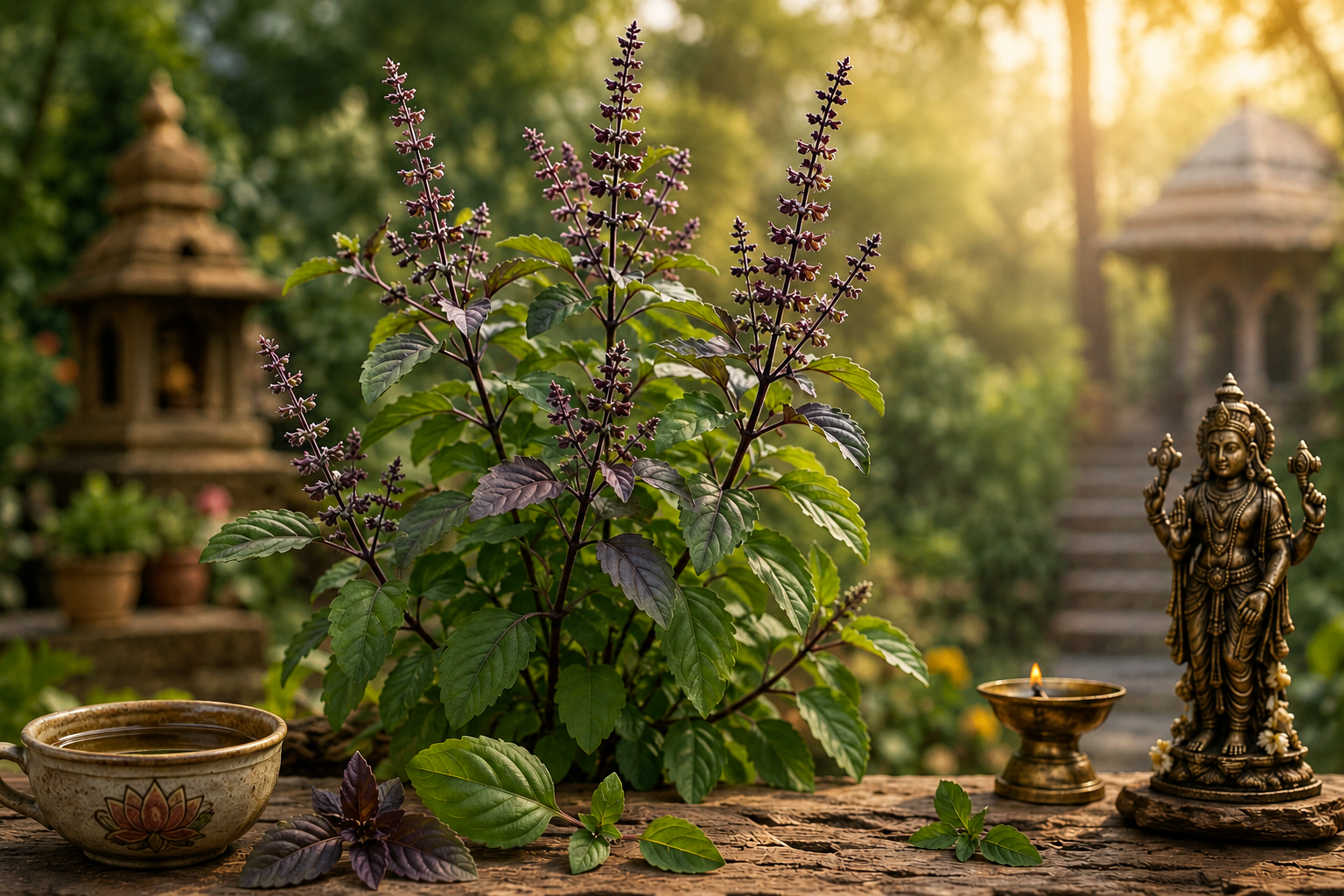
Plant Ally Profile
Ocimum tenuiflorum (syn. Ocimum sanctum)
Adaptation • Clarity • Resilience • Devotion • Vitality • Joy
The sacred basil that teaches steadiness in a changing world.
Tulsi has been called The Incomparable One for thousands of years. In India, where it is known simply as Tulsi, it is more than a medicinal herb. It is a beloved household companion, planted beside homes and temples, tended daily as a living symbol of health, protection, and devotion. Entire families have grown up with Tulsi at their doorstep, drinking her tea, breathing her fragrance, and beginning the day in her presence.
In Ayurveda, Tulsi is considered a rasayana, a rejuvenating herb that supports long life and healthy aging. She is also said to embody sattva, the quality of clarity, harmony, purity, and balanced awareness. Tulsi is traditionally believed to help us return to our natural state of steadiness, goodness, and joy.
Unlike herbs that simply calm or stimulate, Tulsi helps the body remember balance. She is a gentle adaptogen, supporting the body's ability to respond to physical, emotional, and environmental stress without forcing it in any one direction. Modern research has shown benefits for stress physiology, blood sugar regulation, cardiovascular health, immune balance, cognition, and inflammation. Traditional systems have long understood the same truth through different language: Tulsi strengthens vitality while restoring harmony.
More than a thousand years ago, the Persian physician Avicenna described the basils as heart exhilarants, herbs that increase joy and lift the spirit. Modern research now points toward measurable effects on stress physiology, cognition, and emotional well-being, offering a fascinating scientific parallel to this much older observation.
There is something remarkably clear about Tulsi. Her aromatic leaves awaken the mind without overstimulation. She soothes anxious tension while sharpening attention. She encourages resilience without hardness. Rather than helping us escape life's demands, Tulsi helps us meet them with steadier breath, clearer thinking, and a quieter nervous system.
To spend time with Tulsi is to practice resilience as a daily ritual rather than a heroic act.
How To Work With This Ally
Tulsi is an herb for seasons of sustained demand. She is especially appropriate when stress has become a way of life, leaving the mind foggy, the body depleted, or the nervous system caught between exhaustion and hypervigilance.
Drink Tulsi as a daily tea to cultivate long-term resilience. She combines beautifully with Chamomile and Linden before bed, with Ginger after meals, or with green or black tea for gentle cognitive support. I love to combine her with Yerba Mate and Peppermint for a morning tea. During cold and flu season, a stronger infusion can provide comforting respiratory support while encouraging healthy immune function.
Tulsi is equally valuable for those navigating chronic stress, allergic constitutions, fluctuating blood sugar, or the mental fatigue that often accompanies menopause, caregiving, grief, or burnout. Rather than masking symptoms, she helps restore physiological flexibility, allowing the body to respond more appropriately to changing circumstances.
Tulsi is especially supportive when life has become emotionally stagnant, when grief, burnout, prolonged caregiving, or chronic stress have narrowed the world and made it difficult to reconnect with purpose, curiosity, or joy. Because Tulsi is traditionally considered both a tonic and a sacred plant, many herbalists choose to work with her consistently over weeks or months, allowing the relationship to deepen over time.
Tulsi appears in Nervine No. 9, where she provides the formula's adaptogenic foundation. While the surrounding herbs soften, nourish, and quiet the nervous system, Tulsi addresses the landscape beneath it all. Tulsi helps the body adapt to the stresses that created the imbalance, lending resilience, clarity, and emotional steadiness to the blend. She helps the body respond in a balanced way to prolonged stress, eases anxious tension, supports cognitive clarity, and gently restores resilience after seasons of depletion. She is the quiet reminder that healing is not only about calming the storm, but about becoming strong enough to weather it.
Plant Profile
Botanical Name: Ocimum tenuiflorum (syn. Ocimum sanctum)
Family: Lamiaceae
Parts Used: Leaf and flowering aerial parts
Energetics: Warming • Aromatic • Drying • Pungent-Sweet
Primary Actions: Adaptogen • Anxiolytic • Nootropic • Carminative • Immunomodulating • Expectorant • Antioxidant
Traditional Uses:
Stress and exhaustion • Anxiety • Brain fog • Digestive discomfort • Respiratory congestion • Allergic rhinitis • Asthma • Fever • Blood sugar support • Cardiovascular support • Mouth ulcers • Insect bites
Modern Research:
Modern research supports Tulsi's role as a gentle adaptogen with measurable effects on stress physiology, cognition, immune regulation, and metabolic health. Clinical studies have demonstrated improvements in anxiety, cognitive performance, blood sugar regulation, insulin resistance, cholesterol profiles, and immune activity. Laboratory research also suggests antioxidant, cardioprotective, radioprotective, and anti-inflammatory properties, with promising investigation into neuroprotection and adjunctive cancer care.
Notable Constituents:
Eugenol • Ursolic Acid • Rosmarinic Acid • Oleanolic Acid • Beta-Caryophyllene • Linalool • Flavonoids • Apigenin • Luteolin
Plant Themes:
Resilience • Adaptation • Clarity • Sacred Devotion • Homeostasis
Esoteric Correspondences
☉ Sun • ♃ Jupiter • Fire
Purity (Sattva) • Devotion • Vital Force • Protection • Joy
Applications:
Daily spiritual practice • Meditation • Emotional resilience • Heart-centered ritual • Times of transition and sustained challenge
Plant Teaching: Resilience is remembering your center while life continues to change.
Species Note
Several varieties of Tulsi are traditionally recognized. Rama Tulsi is the most commonly cultivated green-leaf variety. Krishna Tulsi bears darker purple-green leaves with a stronger aroma, while Vana Tulsi (Ocimum gratissimum) is a wild forest type. Although each possesses slightly different aromatic qualities, all are used similarly within traditional practice. I work with all three in different applications at Plant Alchemy.
References
Easley T, Horne S. The Modern Herbal Dispensatory.
Chevallier A. Encyclopedia of Herbal Medicine.
Stansbury J. Herbal Formularies for Health Professionals: Volume 1.
Winston D. Adaptogens: Herbs for Strength, Stamina, and Stress Relief.
This profile reflects both traditional herbal knowledge and modern scientific understanding. It is intended for educational purposes and should not replace individualized medical advice. As with all herbal medicines, consider the whole person, their health history, and appropriate safety precautions before use.
