Behind the Bottle | Lineage
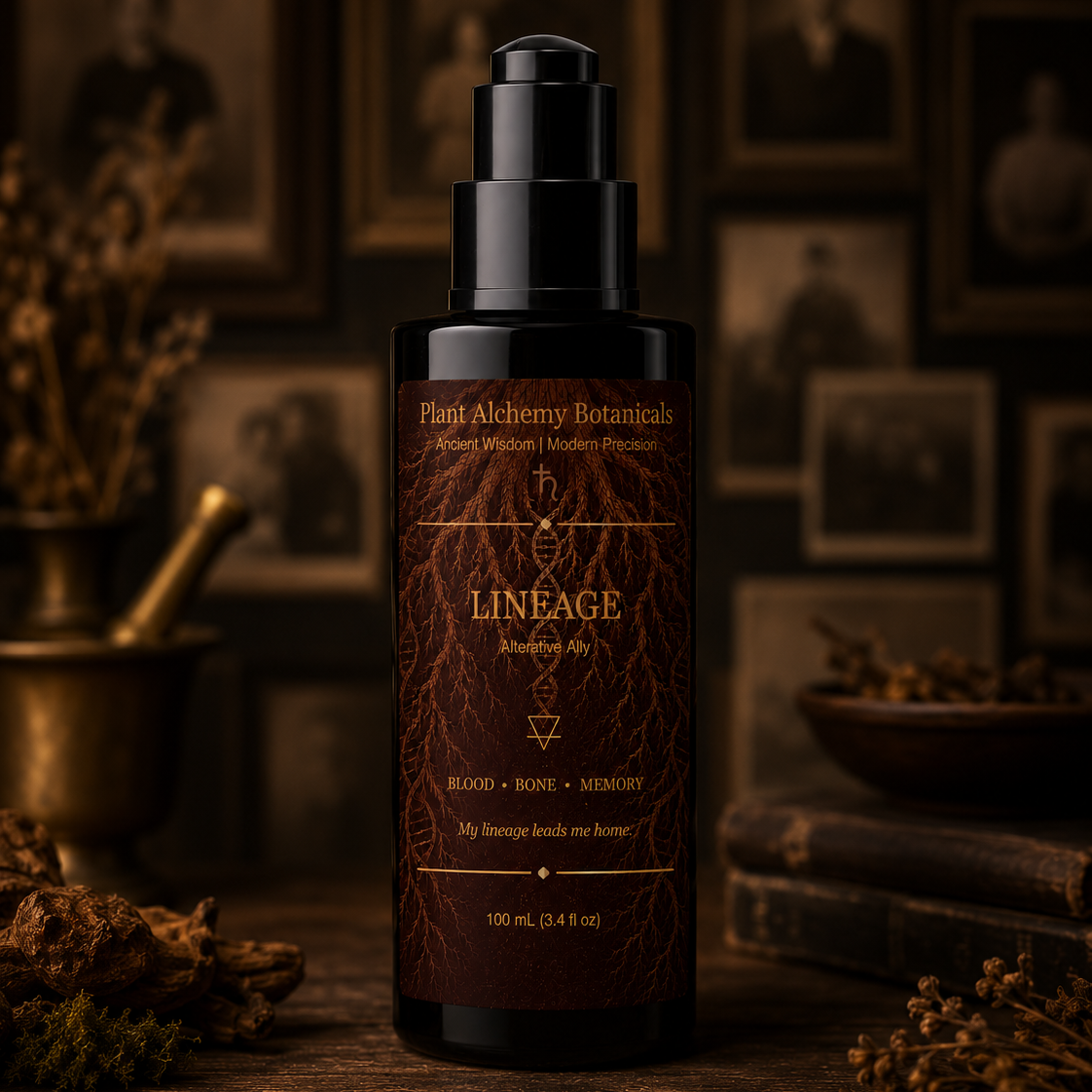
Alterative Ally
Blood • Bone • Memory
What We Carry
We all carry an inheritance.
Some of it is easy to see. The color of our eyes. The shape of our hands. A familiar laugh that everyone says sounds remarkably like someone who came before us.
But why would we believe we could inherit the curve of our mouth and not the impulse to a sharp tongue? Why would we think we could inherit a tendency to heart disease and not the effect of the grief of a previous generation?
Some inheritances are less visible.
The stories told about us before we were old enough to question them. The patterns repeated across generations. The ways our families learned to survive. The careers they pursued. The fears they carried. The resilience they cultivated. The recipes they protected. The love they knew how to give.
We inherit biology, certainly. But we also inherit culture, memory, opportunity, limitation, and belief.
Modern research into epigenetics has opened fascinating conversations about how profound experiences, including chronic stress and trauma, may influence the expression of genes across generations.
This means that, quite literally, you may carry echoes of your mother's trauma, your grandmother's food insecurity, or your father's chronic stress within the biology of your own body. Their experiences may have influenced the way certain genes were expressed, and some of those patterns may be passed from one generation to the next. The science is still unfolding, but it invites us to think about inheritance in ways that reach far beyond DNA sequencing alone.
Long before those discoveries, Indigenous traditions and ancestral healing systems spoke of tending not only ourselves, but the generations who came before us and those who will follow after. Whether viewed through biology, environment, spirit, or all three, inheritance is rarely as simple as DNA alone.
At some point in every life, there comes a time we have to do the inner work. To ask which parts of us were chosen, which were inherited, and which are still waiting to be remembered.
Lineage was born from that part of my own journey.
The Question
Can the body's slow processes of renewal become a teacher, and perhaps even a companion, for the slow work of becoming ourselves?
I have become fascinated by the way our stories about our bodies so often mirror the stories we tell about our families. We speak casually about what "runs in the family," whether we're talking about heart disease, anxiety, stubbornness, resilience, or a gift for music. Some inheritances are written into our biology. Others are shaped by the homes we grew up in, the opportunities available to us, the examples we witnessed, and the stories we absorbed before we had language to question them.
As nurses, we are taught to assess the “socioeconomic determinants of health”. It's medical shorthand for something we all intuitively understand: many of the forces that shape our health are inherited or encountered long before we ever have the opportunity to choose for ourselves.
We receive our family stories almost like nourishment. Some sustain us. Others leave us hungry. Some become medicine. Others become wounds. They shape expectation, identity, habit, and belief. We rarely notice which ones we've swallowed until we begin asking whether they were ever ours to carry.
Inner work is often described as emotional or psychological, but I have experienced it as something profoundly visceral. Deep introspection that reaches all the way into the roots of the body. Down into our bones. Into our blood. Our guts. It asks us to descend into our childhood, family systems, inherited narratives, grief, and memory until we do the work of sorting through what belongs to us and what does not. It can feel as physical as it is emotional, as though the body itself has been waiting for permission to release something it has carried for years.
For me, that realization opened a doorway into the traditional herbal concept of alteratives.
For generations, herbalists have turned to alterative herbs to support the body's deepest systems of renewal. Historically, they were often described as "blood purifiers" or "blood cleansers," not because they literally clean the blood, but because herbalists observed that supporting the organs of elimination often led to healthier skin, stronger digestion, improved vitality, and a gradual restoration of overall health.
These plants gently encourage healthy liver function, lymphatic movement, circulation, digestion, elimination, and the ongoing processes of maintaining healthy blood and healthy tissues. Their medicine is rarely dramatic. At least outwardly. Like any inner work, it is cumulative, foundational, and it requires patience. These plant allies help restore the conditions under which the body can do what it was always designed to do: nourish itself, clear what no longer serves it, and continually renew.
They are, fittingly, often roots, inviting us into the deep root work of body, memory, and inheritance.
I wondered whether their work within the body might reflect the work we are called to do within ourselves. Once I saw the correlation, I knew the medicine had to be born to support this work. It was not simply a formula about detoxification. It had become a medicine about inheritance.
Building the Formula
Lineage arrived almost entirely intact. Unlike some formulas, which reveal themselves herb by herb over weeks or months, this medicine came through in a single, remarkably clear conversation.
Angelica was like a herald, sounding the trumpet that called the rest of the plants to gather. Around her were the traditional alterative medicines: Burdock, Yellow Dock, Dandelion, Red Root, and Red Clover. Together they create the steady physiological foundation of the formula, supporting healthy blood, liver, lymphatic, and kidney function through the gentle, restorative work for which alteratives have long been valued.
Bloodroot appeared early in the formulation process as well. Symbolically, she made perfect sense. But her medicine asks for careful respect and is not appropriate for everyone. In the end, Red Root carried the themes of blood, movement, and restoration while allowing the formula to remain gentle enough for long-term relationship.
Then came the heart.
Rose softens what becomes rigid. Cardamom brings warmth and movement. Licorice Root offers nourishment and harmony.
And Cacao.
Cacao entered this formula for reasons that have very little to do with chemistry and everything to do with relationship. Through ceremony and dieta she has become one of my teachers, embodying remembrance, ancestry, generosity, and heart. I couldn't imagine creating a medicine called Lineage without inviting the medicine of Cacao into the conversation.
What I Hope It Becomes
I hope Lineage becomes a companion and a guide.
A bottle reached for during seasons of therapy, grief, family systems work, inner child healing, and the quiet process of remembering who you were before the world told you who to become.
I hope it supports the slow work of clearing what no longer belongs while preserving every gift worth carrying forward. Physically as well as emotionally and spiritually.
Because healing isn't only about ourselves.
Every pattern we transform becomes part of the inheritance we leave behind.
Closing Reflection
Every family passes something forward.
The question is not whether we inherit.
The question is what we choose to carry. And what we choose instead to transform.
My hope is that Lineage offers gentle support for the body's renewal, the soul's remembering, and the courage to carry forward only what we choose to claim as our own.
May Our Lineage Lead Us Home.
